Thursday, 6 October 2011

MAJOR EXPO OF MAORI ART, CULTURE OPENS IN PARIS

Wood panel by Maori sculptor Tene Waitere
Objects at the Quai Branly Museum in Paris tend to provoke unease and even anger in some visitors. Critics say that the museum, which focuses on the arts of Africa, Oceania, Asia, and the Americas, has a colonialist, outmoded approach to regions outside Europe.

But a new exhibition could change the way the museum is perceived, at least for now. “Maori: Their Treasures Have a Soul” is an impressive show of art and culture organized by the Maori people themselves, and one can feel the difference.

Opened this week, the exhibition presents ancestral treasures along with contemporary artwork, linking the past and the present. Materials used include wood, stone and shell, reflecting the Maori communion with nature, according to Matiu Rei, a Maori “tribal leader” – as he calls himself.

“Ancestry is important to us,” Rei told SWAN. “What canoe our ancestors arrived in is something we want to know about. We still retain that kind of organization, and we genuinely regard ourselves as tribal people with our own ideas of self-determination. That’s what this exhibition is about.”

Rei performed an incantation ceremony before the show opened, blessing the artwork, as the Maori believe that objects “can have a spirit”, he said.

The show, composing 250 pieces, has traveled from the Museum of New Zealand Te Papa Tangarewa, where it was first presented earlier this year. Rei said that the exhibition “looked better” in Paris because of the large and attractive space the Quai Branly Museum could devote to it. This space means that visitors can take their time to wander among the exhibits, appreciating the various themes being portrayed.

One learns about the Maori skill at sailing, with depictions of their canoes and paddles; traditional Maori music, with musical instruments on display; contemporary Maori art, with works from artists such as Reuben Paterson and Brett Graham. 

Maori oars
Other objects include stunning jade pendants, tall wooden sculptures of ancestral gods, photographs depicting ornate tattoos, and historical documents. They all show Maori culture as seen by Maori, “free from Western views and biases,” the museum says.

The main thread throughout the exhibition is the resolve for empowerment, leadership and identity in New Zealand, after centuries of “dispossession and colonial conflicts”, said Stephane Martin, president of the Quai Branly Museum.

“The approach of this exhibition is different from one done by ethnographers or collectors,” Martin told SWAN. “This show has been done by Maori people in the way they want to be seen or perceived.

“It’s a very large vision of the Maori world, from its origins to the present situation, following a chronological line,” he added.

Asked about the criticisms of the museum’s general focus, Martin said that the Quai Branly wanted to be seen as a “cultural centre” rather than as a “real traditional ethnographic” museum.

“We give voices to very, very different points of view,” he said. “When people came to the opening of the museum and said ‘I don’t like this museum’, what they disliked were very small parts of the museum.”

He said that the temporary exhibitions were distinct from the permanent objects in the museum’s so-called Espace de Référence (Reference Space), which houses traditional pieces from regions outside of Europe. The presentation of these pieces as “primitive arts” is the reason many people are uncomfortable with the museum, which was created in 2006. 

But visitors at the opening of “Maori: Their Treasures Have a Soul” said that they welcomed an exhibition organized by the community that was being portrayed.

“This is a good approach,” said Djamal Mohamed, as he viewed a sleek, imposing canoe on display. “I’m learning a lot.” - A.M.

The exhibition runs until 22 January 2012. Side events include dance workshops, storytelling shows, and the projection of films such as “Whale Rider” and “Once Were Warriors”.

Friday, 30 September 2011

REMEMBERING TRINIDADIAN ARTIST PAT BISHOP

Artwork by Pat Bishop
Last month, Trinidadian artist Pat Bishop passed away. There is no better way to define Bishop than as a "Trinidadian artist”, because she actually covered all the possible artistic expressions that her beloved island could offer. She was a visual artist, a writer, a scholar, a theatre director, a musician and an artisan of mas.

She mastered all the arts of Trinidad and, in doing so, she took the arts of her country forward. Music was often part of her sculpture, and the colours she used for her paintings were the same as the ones she could draw out of her steelpan. She had someone send her pigments from Rome, from a little shop close to the Pantheon, because she said that colours coming from such a beautiful place, close to so much art, would surely shine more.

I met Pat during one of my stays in Trinidad, when I went for an interview about Carnival. I came away with one of the most touching afternoons of my life, but no interview. She asked me many times where I came from, where my parents came from, what I did before, what they did, how was the landscape where I lived, what had brought me to Trinidad. Then she told me you can never look at somebody’s work, without knowing where this person comes from.

I guess there is no better way to look at Pat Bishop’s work as a multifaceted artist than to look at the beauty of her island, which she helped improve, and to view some of her creations from a memorable exhibition held in Port of Spain in 2009. - Giuseppe Sofo

Saturday, 17 September 2011

DIVERSITY FETE LIVENS UP PARISIAN STREETS

Performers in the “Défistival”, Sept. 17, in Paris.
Each year, France's “Défistival” gets bigger and more colourful, and this year it lived up to expectations with dance, live music and eye-catching floats in the streets around the Eiffel Tower.

Celebrating diversity, the festival includes disabled people and groups that represent different cultures. The 2011 event had a special focus as this is the Year of France's Overseas Territories, the European Year of Volunteering, and the International Year of Forests. For details: http://www.defistival.org/.

One of the floats in the annual “Défistival”.

Monday, 29 August 2011

NEPAL TO HOLD FIRST LITERARY FESTIVAL

Known for its mountains, Nepal might not seem an obvious locale for a literature festival, but the organizers of the first “Kathmandu Literary Jatra” aim to change this perception.

Suvani Singh
The festival, to be held from Sept. 16 to 18, will provide “a platform for local-language literature to engage with its international counterpart” and will also play a pivotal role in bringing Nepali writing to the global stage, says festival director Suvani Singh.

She and her colleagues point out that although Nepal has a strong oral tradition, the nation has long been defined “through the prism of under-development”.  The literary festival is thus a means to show Nepal’s “cultural wealth and change the singular narrative through which it is known internationally,” they add.

Singh says that the idea for the festival began after some Nepali writers attended the Jaipur Literature Festival in India and the experience was widely written about in the local media.

“The idea for the event has generated a lot of interest and excitement here in Kathmandu,” she told SWAN. “Everyone is keen to celebrate literature and ready to discuss different ideas and issues that are relevant in the sub-continent.”

Singh herself got involved because of her love of books and her experience in holding small literary events at a bookshop she runs in Kathmandu called Quixote’s Cove.

Free to the public, the festival will hold readings, talks, discussions, and performances at public venues on topics related to literature and language. Ten international and 50 national writers and poets have been invited, and the organizers promise “extensive interaction between the authors and readers”.

The festival also has the worthy aim of boosting literacy. In the run-up to the event, the organizers said in a statement: “Literacy allows for access to information and opportunities to pursue a better future. As Nepal enters the second decade of the 21st century, it has a population approaching 30 million and a literacy rate slightly above 50%. Reading and writing is only just starting to become a feature of Nepali culture and lifestyle. Till now literature in Nepal has largely been insulated within the languages of Nepal. As a result, the Nepali voice and conscience are largely absent from the global stage.”

Singh personally hopes the festival will help to change this. She says that the sessions planned cover a wide range of topics to reach out to a more diverse crowd, from intellectuals to people who rarely read books.

“There will be lots of parallel activities which will engage even those who normally wouldn't attend literary events,” she told SWAN. “It will hopefully give everyone who attends a memorable experience.” – A.M.


Tuesday, 2 August 2011

REGGAE SUN SKA SET TO ROCK THE VINEYARDS

German reggae singer Patrice
The small town of Pauillac in southwest France is known more for red wine than for music, but from August 5 to 7 the region’s vineyards will rock to the sounds of Reggae Sun Ska, one of Europe's biggest reggae festivals.

The annual event in the heart of the Bordeaux region features musicians from Jamaica and other countries, and the organizers say they expect more than 50,000 spectators to turn up this year for the 14th anniversary.

Reggae veterans such as Big Youth, Toots and the Maytals, the Heptones and Linton Kwesi Johnson will share the stage with younger artists including the German singer Patrice, Jamaican diva Etana, and rising star Romain Virgo, winner of a major music competition in Kingston.
Stephen Marley

Stephen and Ky-Mani Marley, two of Bob Marley’s sons, and Andrew Tosh (son of Peter) will also be on hand - not only to remind fans of the heyday of reggae and the trail-blazing music their fathers created, but to present their own compositions as well.

Other scheduled performers hail from New Zealand (Katchafire and Ladi6), Guinea (Takana Zion), Guadeloupe (the energetic Admiral T) and Australia (Mista Savona).

Mainland France, which has numerous reggae groups, will be represented by artists such as Dub Inc., Wicked System, and Raggasonic Sound System, according to Sun Ska’s organizers.

Festival spokesperson Sophie Cadrouilh says the event aims to generate lots of “positive vibrations”, which may well be enhanced by some of the local wines. But the festival will also be environmentally friendly, with the use of bio-degradable cups and plates, and a solar generator providing some of the electricity.

The organizers have urged spectators to use public transportation or to team up with others when traveling by car. They’ve also made space available for free camping during the festival. See http://www.reggaesunska.com/ for more details.  - A.M.


Friday, 15 July 2011

ONE MILLION ATTEND ANTI-DISCRIMINATION CONCERT

About one million people attended SOS Racisme's Concert for Equality on July 14 (see article below)

Wednesday, 13 July 2011

CONCERT FOR EQUALITY

Julian Perretta
The Champ de Mars park around the Eiffel Tower in Paris will be the site of what promises to be a massive anti-racism concert on July 14, the French National Day.

Featuring performers such as Julian Perretta, VV Brown and Shy’m, the show aims to make a statement against the perceived rise in xenophobia in the country.

“We want the politicians to realize that there are many of us willing to defend the notion of equality and the policy of living together in harmony,” said Dominique Sopo, president of SOS Racisme, the anti-racism group that is organizing the concert.

“We are against racism, sexism, homophobia,” he told SWAN. “This is a concert for equality.”

The many musicians who have volunteered to participate are doing so because “they agree that the principles of equality need defending,” Sopo added.

The lineup in fact reflects the multicultural France that some would prefer not to see. Prominent among the performers are Yannick Noah, the dreadlocked former tennis star who is now a singer, and Nèg' Marrons, a French dancehall group whose members originate from Cape Verde, Congo and Martinique.

Shy'm
Most of them have already spoken out against racism. In addition to the musicians, Sopo said that a significant number of French residents were disturbed by the support for the far-right, anti-immigrant National Front (FN) political party. Polls suggest that FN leader Marine Le Pen could gain more 20 percent of votes in the French presidential elections next year.

“One always has to be on guard when it comes to parties such as the FN,” Sopo said. “They are now claiming that they are not extreme-right, but they stigmatise certain groups and this is unacceptable. Their values are totally opposite to the values of our republic. We want the presidential elections to be based around equality and not stigmatization.”  

He said the concert is a means to raise public awareness as well as to mobilize people. It’s been 20 years since SOS Racisme staged a similar outdoor event, and the group believes the times are calling for another stand against discrimination.

Yannick Noah
“These past years have in fact been marked by an offensive that must now be stopped – an offensive by those who cynically believe that the time has come to unravel the conditions of living together and to stamp on the most elementary principles of humanism,” the group said.

In the hours before the concert, SOS Racisme will be joined by other non-governmental organizations, such as Amnesty International, in an NGO Village at the Champ de Mars. They will hold debates and present material on the work they do.  - A.M.

Wednesday, 22 June 2011

WHITAKER NAMED AS UNESCO GOODWILL AMBASSADOR

Whitaker and Bokova at UNESCO
Forest Whitaker, the American actor and activist, has become the latest goodwill ambassador for the United Nations Educational, Scientific and Cultural Organization.

At a ceremony on June 21 at UNESCO’s headquarters in Paris,  the agency’s director-general Irina Bokova said Whitaker was chosen for his humanitarian and artistic commitment.

““He brings compassion and commitment and feeling to what he does in this world of turmoil,” she told us. “I think it’s a wonderful kind of synergy between us and him for outreaching to communities.”

She said that Whitaker’s nomination as “Goodwill Ambassador for Peace and Reconciliation” was important to the agency as the actor would bring visibility to UNESCO’s messages about “peace, education, reconciliation”.

Whitaker, who has always portrayed unusual characters, is perhaps best known for his roles as jazz musician Charlie Parker in “Bird”, for which he won the Palme d’Or in Cannes for best actor in 1989,  and as deranged Ugandan leader Idi Amin in “The Last King of Scotland”, for which he received  an Academy Award in 2006.

He also works on projects that reflect his humanitarian concerns. He has produced a poignant film about Ugandan child soldiers as well as a documentary about the need to achieve peace and understanding in strife-torn communities.

Whitaker speaks to fans
Whitaker, 49 years old, said the relationship with UNESCO would result in a number of new initiatives.

“I have a plan to start work in training youths in peace and reconciliation in different regions of the world in conflict and to work with UNESCO on building an international institute for peace,” Whitaker said.

“I’m just gonna try to walk alongside, walk behind, carry the bags and do as much as I can to make it work,” he added. “I’m hoping I’ll be able to go out and connect with others in order to further the message of UNESCO.”

In October, Whitaker will participate in the organization’s Youth Forum at the 36th General Conference. He will be the keynote speaker and will present documentary and advocacy films, focusing on peace and reconciliation initiatives, UNESCO said.

The actor’s nomination as goodwill ambassador comes on the heels of a visit to UNESCO’s headquarters by U.S. Secretary of State Hillary Clinton. Her address to the agency’s delegates in May was the first time that an American secretary of state had visited the institution. It seems that after years of being considered the UN’s unloved and controversial child, UNESCO is finally coming in from the cold. - A.M.

Tuesday, 21 June 2011

CAPTURING THE SPOKEN WORD IN BOTSWANA


 TJ Dema (photo by Thomas Pirel)

Botswana poet TJ Dema is set to make a global mark this year. Fresh from performing at the Harare International Festival of the Arts (HIFA) in Zimbabwe, she is now putting the finishing touches to a recording of 12 Batswana poets/spoken word artists on one CD.

“Hopefully this multi-lingual albeit mostly English project titled 'Dreaming is a gift for me' will be out late July/early August as we are entering the post production phase,” she tells SWAN.

At HIFA, a six-day annual festival and workshop programme that showcases local, regional and international arts and culture, Dema performed in April with an eclectic ensemble. The group comprised Zimbabwean poet Dikson, Norwegian composer and instrumentalist/vocalist Cecilie Giskemo, Norwegian guitarist Asbjoern Lerheim and Zimbabwean saxophonist Vee Mukarati.

Giskemo composed music specifically for poems by Dema and Dikson, and the poets performed the sets live. There are now plans to take the production on tour, Dema says, with a show called “Sonic Slam Chorus.  Check out the audio samples at: http://soundcloud.com/dikson/these-women-by-sonic-slam

Dema first came to our attention last year at the fourth Shakespeare & Company Literary Festival in Paris, France. She stood out with her spoken-word performances, covering subjects that ranged from lost childhood to domestic abuse.

Her skills with rhythm and drama made everyone in the audience sit up and listen. This was literary rap that impressed with the dexterity of the wording, the unexpected placing of the beat, and the profound subject matter.

In an interview after that festival, TJ told us that she doesn't consider herself a political writer because she is "wary of boxes and titles" and prefers not to be compartmentalized.

"My poetry is a mixture of the personal and the political," she said. "The effect is a little less confrontational so that people are willing to listen. The work isn't autobiographical as some might think, but I try to make it authentic."

TJ, now 29 years old, said she draws her inspiration from what happens around her, and she's motivated by the need to make a difference.

"I'm not trying to save the world but I do think that stories can change perspectives and then you can be able to make informed decisions," she said.

"I think sometimes we are so happy that we forget that terrible things are happening. And it doesn't have to be happening to a million people, it can be just one person who still needs to have her or his story told," she added.  –A.M.

Thursday, 24 March 2011

USING THEATRE TO OPEN EYES

PARIS - March 24, 2011

African drama was in the spotlight on World Theatre Day, celebrated on March 23 with an evening of thought-provoking performances at UNESCO, the United Nations' cultural agency based in Paris.

The African playwrights who participated said that they wanted to use drama to promote development and peace, and they appealed to world leaders to consider the possibilities of theatre in raising awareness among ordinary people.

"While nations spend colossal sums of money on peace-keeping missions in violent conflict areas of the world, little attention is given to theatre as a one-on-one alternative for conflict transformation and management," said Jessica Kaahwa, the Ugandan playwright known for using theatre to foster community development.

Kaahwa was the honoree of the event, and she presented the world premiere of  Putting Words Between The Eyes, a 20-minute, one-act play that she created especially for World Theatre Day.

Thembi Mtshali-Jones
Set in the fictional republic of Sarkina, which has just gone through a protracted violent conflict, the play looks at how people try to rebuild shattered lives.

It also shows well-meaning ambassadors trying to overcome their despair in the face of failed peace resolutions, as both civilians and peacekeepers get caught in the "dilemma of hope and distrust", according to Kaahwa.

The play evoked the current conflicts in Libya and elsewhere in North Africa and the Middle East, with its sense of desolation and the sound effects that included the screaming of warplanes and the firing of guns.

"Theatre subtly permeates the human soul gripped by fear and suspicion, by altering the image of self - and opening a world of alternatives for the individual and hence the community," Kaahwa said in her keynote message.

In Uganda, Kaahwa has used drama to raise awareness of human rights as well as gender rights, according to Tobias Biancone, secretary general of the International Theatre Institute, a non-governmental organization associated with UNESCO that organizes World Theatre Day.

"We respect those who use theatre to improve nations, cherish those who bring theatre to neglected members of the community: the young, the old and the poor," Biancone said. "We hold in high esteem those who use theatre to bring peace to conflict zones; we value politicians and policy makers who understand the value of theatre and fight with us for funding and for education in the performing  arts."

Uganda's deputy head of mission, Philip Odida, said that the focus on Africa for World Theatre Day revealed that the continent's creative arts were rich and flourishing and undergoing renewed growth as a result of new information technologies.

The playwrights and performers showed that theatre "goes beyond entertainment, and also serves as an important means of instruction, information and education," Odida said.

Many attending the event seemed to agree as they commended the performances of actors such as Thembi Mtshali-Jones who used humour, dance and song to convey the painful experiences of a child growing up under apartheid in South Africa.

The 15-minute extract of her one-woman play, A Woman in Waiting, was one of the best features of the evening. International in scope, it also addressed the problems of domestic workers who leave their children behind to be raised by grandparents - sending home shoes and clothes that no longer fit.

"The play was powerful and extraordinary because through the performance she managed to get us back to South Africa and to her childhood where the laws were such that domestic workers had to be separated from their children, seeing them only once a year," said Vanessa Mkhize-Albertini, a Paris-based South African activist.

"The child had to wait for the mother to return to get her, and even when she finally got to live in the city with her parents, she still had to wait for the mother to come home from working," Mkhize-Albertini added. "That's the reason for the title."

In an interview, Mtshali-Jones said that she especially wanted to reach out to young people with her autobiographical play.

"It's important for those who didn't live through apartheid to know this story," she told us.  "Some people say let's forget about it now and move on. But you have to know where you've been to get to where you're going."

Mtshali-Jones' own story could serve as an inspiration to others. She worked as a domestic servant and used to sing for her employers' dinner guests before she auditioned for a play and got an acting role. That first production was seen by white audiences only because of the racial laws.

The play was a success, however, and Mtshali-Jones was able to act in others, going on tour to countries such as Nigeria and England, which opened her eyes to a different world.

"In Nigeria, I saw a black country being governed by black people and that experience changed me forever," she said.

She eventually was able to study in the United States, where she met the legendary South African singer Miriam Makeba. She worked with Makeba for a number of years and returned to her homeland in 1985. Since then, her acting and playwriting has been not only to tell stories, but to raise awareness, she said.

Isaac Kemo (photo by Alecia McKenzie)
Like Mtshali, but in a different vein, an actor and writer from the Central African Republic, Modeste Nzapassara, used humour to convey a serious topic on World Theatre Day. He had the audience laughing out loud with his portrayal of the immigrant experience in France.

In an excerpt from Black Bazaar, based on the novel by Alain Mabanckou, he showed how ignorance about immigrants' origins can lead to some absurd encounters, as when people in the host country confuse the Democratic Republic of the Congo with the Republic of the Congo and lecture immigrants on what needs to be done "over there".

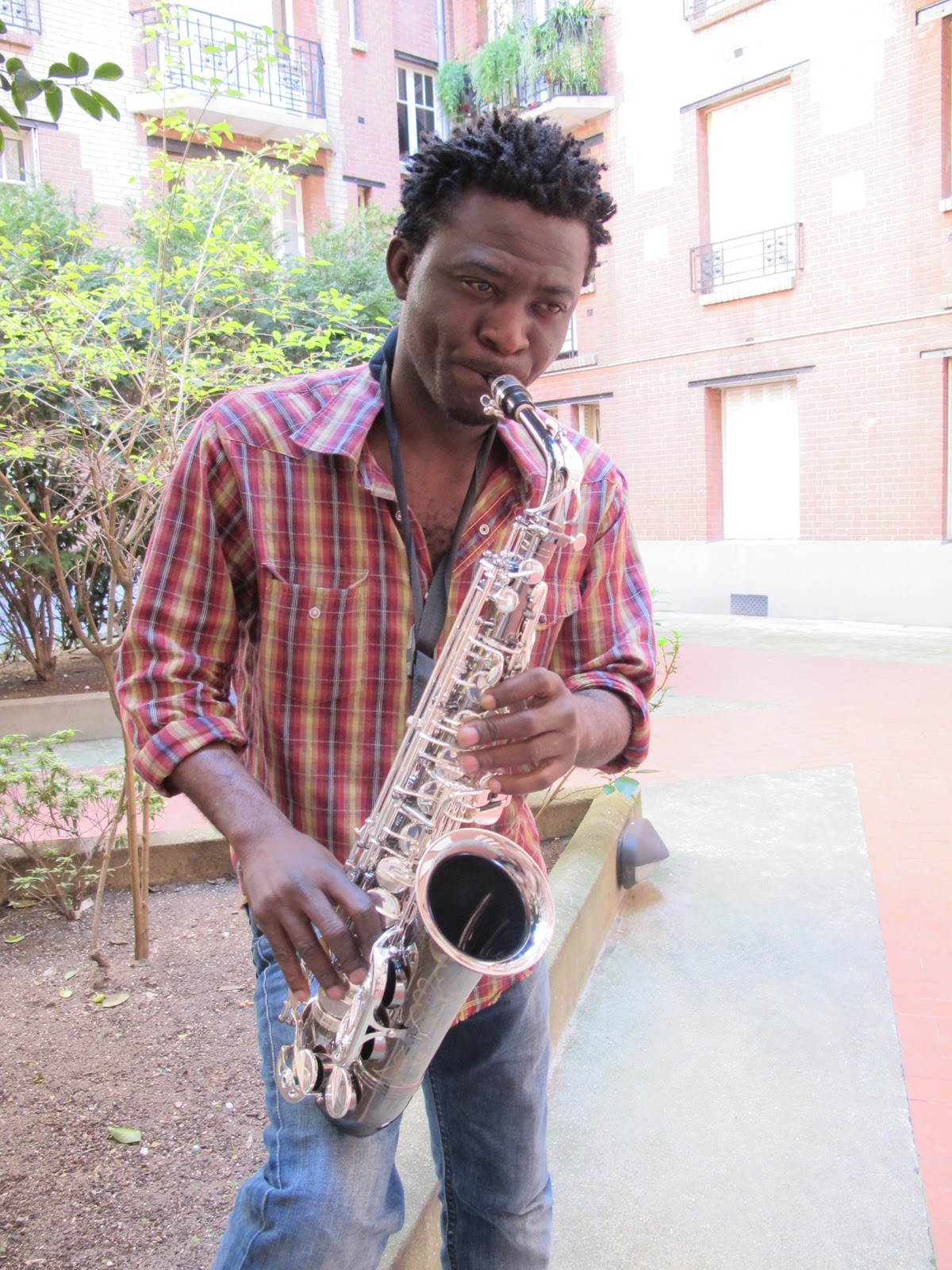
One bit of disturbing news at the UNESCO event was that a percussionist troupe invited from Sudan was absent because they were unable to get visas to enter France. Luckily for the audience, however, the talented Ivorian saxophonist Isaac Kemo was able to step in with his backing band of drummers and provide uplifting music for the evening. - A.M.