Friday, 29 May 2015

IN FRANCE, THE COMMEMORATION OF SLAVE ANCESTORS

By Brenda F. Berrian

It is a cool afternoon at the Place de la République in Paris, and, clad in black, several people of Caribbean descent are kneeling on the pavement to form Le Brick, or la fresque humaine (The Brick, or the Human Fresco), with their bodies flat on green mats to duplicate the way in which their departed ancestors had been packed onto the bottom of a slave ship.

People attending the commemoration.
Photo: Brian Cook / Golden Sky Media
This is May 23, 2015, and the participants who make up la fresque humaine are among more than 30,000 people of Martinique, Guadeloupe, French Guiana, Réunion and various other ethnic origins at the 17th annual memorial commemoration of slave ancestors.

The free 13-hour Limyè bayo (Light for Them) program, with the themes of Acknowlegement and Reconciliation, also includes vendors, speakers, dancers and a free concert. 

This celebration is held under the auspices of Le Comité Marche du 23 mai 1998 (The Committee for the March of May 23, 1998, or CM98). This group lobbies the French government on issues related to Caribbean history, including the National Assembly’s passage of the 2001 Taubira Law and the inauguration of a holiday to commemorate the abolition of slavery.

Serge Romana and Joycelyne Beroard
Photo: Brian Cook / Golden Sky Media
“We have come to honor our great-grandparents,” announced Serge Romana from the stage set up at the Place de la République.

Romana, who's a Guadeloupean professor of medicine and president of CM98, served as one of the evening’s hosts.  “The holiday erases the shame that people feel upon hearing the word slavery…The name I carry is my great-grandmother’s that was given to her in 1848, when slavery was abolished. It isn’t so long ago,” he said.

After her performance, Jocelyne Béroard, the Martinican singer of the band Kassav’, said: “In Martinique, everyone wanted to forget about slavery and its history. For them, slavery symbolized pain. They had to deconstruct what was constructed in their minds. When Guy Deslauriers’ 2003 movie The Middle Passage about the indignities and sufferings of slavery on a ship from Africa to the New World was shown, people walked out and demanded back their money whereas I cried. They and I must know our history in order to move forward.”
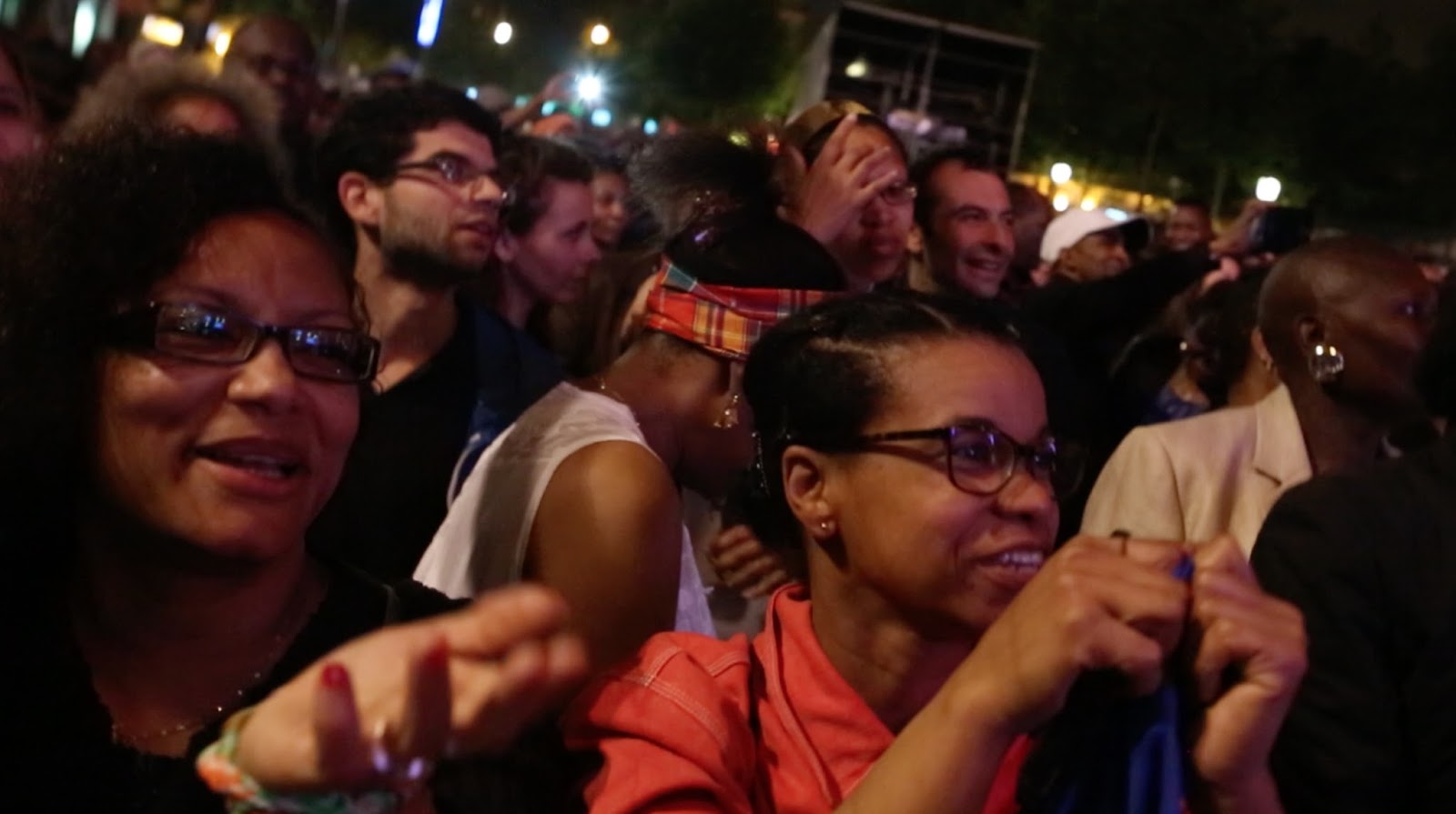
Spectators enjoying the concert.
Photo: Brian Cook / Golden Sky Media
CM98 was founded after the Paris march of May 23, 1998, in which 40,000 people including Caribbean nationals, Africans and Europeans protested  racial discrimination in complete silence from la Place de la République to la Place de la Nation. The CM98’s main purpose was the rehabilitation and defense of the memory of colonial slave ancestors who were based in French Guiana, Martinique and Guadeloupe.

The march was unprecedented because not more than 1,000 or 2,000 Caribbean people usually showed up for other marches. This time, however, the Caribbean population chose to celebrate the 150th anniversary of the abolition of slavery to ensure that the present and future generations would know their true history, which had not been taught in the French-oriented school system through the Caribbean islands.

Christiane Taubira
 (photo: SWAN)
In June 1983, the French Republic instituted the commemorations of the abolition of slavery throughout the overseas departments (DOM-TOM). The law of June 30, 1983, accorded a holiday to the departments. Then, on May 23, 2001, the Taubira Law was passed by the National Assembly to recognize that slavery was a crime against humanity. In 2008, after many debates, May 23 was chosen as the official date to honor the slave ancestors in France. Yet Martinique continues to celebrate the abolition of slavery on May 22; Guadeloupe on May 27; and French Guiana on June 10.

On Saturday, 17 years later, people of all walks of life were in attendance with V.I.P. guests such as George Pau-Langevin, the Minister of the Overseas Departments; Christiane Taubira, the Minister of Justice who lent her name for the 2001 law; and Anne Hidalgo, the Mayor of Paris. The free musical concert, with the Martinican journalist Marijosé Alie as the Mistress of Ceremony, included entertainers from Guadeloupe, Martinique and Haiti. The legendary Tabou Combo, the Haitian compas group, gave special tribute to Haiti. Live coverage of Limyè bayo was provided by a number of television networks.

It was a celebratory evening that gave voice to the fact that the ideas of liberty and freedom matter to all. La Place de la République, the largest pedestrian area in Paris, also symbolized a space where people meet to exchange various viewpoints.

Brenda F. Berrian is Professor Emerita of Africana Studies, University of Pittsburgh (USA).

Monday, 25 May 2015

FILM ABOUT MIGRANTS IN PARIS WINS CANNES' TOP PRIZE

The 2015 Cannes Film Festival awarded its top prize to a film about a trio of immigrants from Sri Lanka trying to adapt to a tough urban environment in Paris.

Jesuthasan Antonythasan in Dheepan
Dheepan, by French director Jacques Audiard, won the Palme d’Or for the story of a former Tamil Tiger fighter in the Sri Lankan civil war who immigrates to France with a fake family - a “wife” and “daughter” he hardly knows - and faces new challenges that require his old skills.

Many critics were surprised by the choice, but others said the Jury (headed by famed American filmmakers Ethan and Joel Coen) had made a bold decision in awarding the prize to a film about such outsiders, not normally the stars of big-budget movies.

Britain's Independent newspaper called Dheepan  “a radical and astonishing film that turns conventional thinking about immigrants on its head, and takes a faceless immigrant coming from a war barely covered in the media and turns him into a [kind of] anti-hero”.

A scene from Dheepan (photo P. Arnaud)
The movie stars the France-based Sri Lankan writer Jesuthasan Antonythasan, who drew on elements in his own background for his screen portrayal, and Indian actress Kalieaswari Srinivasan, who plays his fake wife.

They arrive in Paris with their young “daughter” - a girl they have to travel with to give the semblance of a family - and end up in a bleak suburb of the capital, rife with crime. The film shows the unusual ways they find to cope with their new situation.

Some of the festival’s other prizes were more predictable. The Grand Prix (or second prize) went to the Hungarian Laszlo Nemes for his moving Holocaust drama Son of Saul while the Jury prize was given to Greek director Yorgos Lanthimos for his futuristic (and stomach-turning) story The Lobster, about people being forced to choose a mate or risk being turned into animals.

Hou Hsiao-Hsien (by Yao H-I)
Chinese filmmaker Hou Hsiao-Hsien was named best director for his martial-arts thriller The Assassin, and the best screenplay prize went to the young Mexican helmer Michel Franco for Chronic, about a nurse who works with terminally ill patients and who needs them as much as they need him.

Veteran French performer Vincent Lindon was named best actor for La Loi du Marché (The Measure of a Man), the story of a long-time unemployed worker who finally gets a job that turns out to be utterly soul-destroying. But in perhaps the biggest surprise of the night, Rooney Mara of female-love-story Carol, and Emmanuelle Bercot of destructive-relationship tale Mon Roi were jointly awarded the “best actress” prize.

Blanchett in Carol
Cate Blanchett, who probably gave the greatest performance of her career in Carol - an understated story about love between women in 1950s America - was inexplicably left out of the awards.

In the festival’s Un Certain Regard segment, comprising innovative and off-beat films, the top prize went to Grímur Hákonarson of Iceland for Rams, about two brothers reconciling to save their beloved animals, while Croatian director Dalibor Matanić won the Jury Prize for  Zvizdan (The High Sun), a literally heart-breaking and no-holds-barred look at the dangers of loving across ethnic lines in the Balkans.

Japan's Kiyoshi Kurosawa (no relation to the iconic Akira Kurosawa) meanwhile won the best director award for Kishibe No Tabi, or Journey to the Shore, a mystical tale about a husband who returns home three years after drowning at sea. 

The Avenir prize was awarded jointly to two talents to watch out for: Indian director Neeraj Ghaywan, for Masaan, a story about  moral choices; and the Iranian filmmaker Ida Panahandeh, for Nahid - about a divorced mother’s struggle to keep her children. Panahandeh was one of the few women directors represented at Cannes, an on-going issue for the festival.

A film still from Masaan (photo: K. Mehta)
In addition, Colombia’s Cesar Augusto Acevedo received the Camera d’Or (best first feature) for La Tierra y la Sombra, or Land and Shade, a film about a man going back to his family some 17 years after abandoning them and shown in the Semaine de la Critique section of the Festival, a sidebar to the Official Selection.

But here again, missing from the awards was the critically acclaimed Lamb by Ethiopian first-feature director Yared Zeleke (see SWAN’s previous article).

Lamb was one of our favourite movies shown at the festival, along with Mia Madre by Italian director Nanni Moretti. The latter, which touchingly depicts the grief that comes with a mother’s last days, also went away prize-less, just like the superb Timbuktu last year. With films, though, one person's feast is always another person's flub. - A.M.

(The Cannes Film Festival ran from May 13 to 24. For more information: http://www.festival-cannes.com)

Friday, 22 May 2015

ETHIOPIA’S FIRST MOVIE AT CANNES FESTIVAL IS A HIT

A scene from Lamb: Ephraim and his pet sheep head home.
A boy, a sheep and a stunning mountain landscape. These are the three stars of Lamb, a poignant film directed by 36-year-old Yared Zeleke that is Ethiopia’s first entry in France’s prestigious Cannes Film Festival.

The movie was added after the announcement of the official selection in April and was warmly received in Cannes at its premiere on May 20, with the director and cast receiving applause. It’s slated for general French release later this year, Zeleke said.

Ephraim and Chuni
Shot in the highlands and forests of both northern and central Ethiopia, Lamb tells the story of nine-year-old Ephraim (Rediat Amare) and his beloved pet, a sheep named Chuni. The animal follows Ephraim around like a devoted dog, and plays the role of best friend, albeit one who can only say “ba-a”.

When the film begins, we learn that Ephraim has lost his mother in an on-going famine, and, to survive, his father has decided to take him to stay with relatives in a remote but greener region of their homeland, an area of intense beauty but increasing poverty. Ephraim will have to stay there while his father seeks work in the city, not knowing when he can return.

The relatives are an intriguing bunch. There’s the strict farmer uncle who thinks Ephraim is too girly (the boy likes to cook), his wife who’s overworked and worried about her small, sick child, a generous matriarchal great aunt who tries to keep the family in line with a whip, and an older girl-cousin - Tsion - who spends her time reading and with whom Ephraim eventually bonds.

Soon after arriving in their midst, Ephraim is told by his uncle that he will have to learn what boys do: he will have to slaughter his pet sheep for an upcoming traditional feast.

A poster for the film.
The news pushes Ephraim to start devising ways to save Chuni, and that forms the bulk of the storyline, while the film subtly highlights gender issues, the ravages of drought and the isolation that comes from the feeling of not belonging. Throughout it all, the magnificent rolling hills are there, watching.

We learn in passing that Ephraim is half-Jewish through his mother, whom the relatives refer to as “Falasha people”, but Zeleke says that this is not at all meant to signal division, as Ethiopians don’t generally identify themselves according to religion. In fact, the Christian relatives all seem to have admired the mother.

They attribute Ephraim’s skill at cooking to her teaching, and some of the most moving moments are centred on food – feeding and being fed by a loved one.

The film is dedicated to the director’s grandmother, and another striking element is how sympathetically women are portrayed. Tsion, played by the smoldering Kidist Siyum, is shown as smart and knowledgeable, but her love of reading is considered useless by the family since it doesn’t get the back-breaking household chores done. Ephraim’s ability to cook and sell samosas on the market is seen as more helpful, drawing attention to some of the hardships children face in poor countries.

The title could even be taken as a reference to the treatment of the world's youngest and most vulnerable citizens.

Director Yared Zeleke
Lamb shows Tsion being pushed to make a sad choice, leaving Ephraim more alone than ever, but the film ends on an upbeat note, with the possibility of acceptance. A simple and unforeseen act of kindness towards Ephraim by Tsion’s rejected suitor might trigger most viewers’ tears.

As a first feature, Lamb is a glowing success for Zeleke, who grew up in central Adisa Ababa - an urban environment where he says he didn’t have a pet and never learned how to cook - and who went on to study film-making at New York University. With the credible story and the feel of authenticity, the director shows that he knows his culture and people.

The loving attention to the landscape and the tight focus on his characters also reveal confidence and vision, and members of the cast equally turn in a fine performance. As Ephraim, Amare Rediat is affecting and sincere, with his huge expressive eyes, and Siyum has a coiled energy that conveys the frustration of a bright girl expected to marry and “breed” quickly because that is her only fate.

Produced by Slum Kid Films, an Ethiopian production company that Zeleke co-founded with Ghanaian colleague Ama Ampadu, Lamb was shown in Cannes’ Un Certain Regard category. This section highlights daring, innovative, off-beat works, and Zeleke’s film certainly fits the bill. - A.M.

Photos are courtesy of the film's producers. For a more complete article, please go to:

Saturday, 9 May 2015

ART SHOW CELEBRATES JAMAICA’S ‘NATURAL BEAUTY’

The recently opened north-coast branch of the National Gallery of Jamaica is hosting a new exhibition titled Xaymaca: Nature and the Landscape in Jamaican Art, scheduled to run until August 2015 in Montego Bay.

The show's poster, with a detail of Colin Garland's
"In the Beautiful Caribbean" (National Gallery).
“Xaymaca” was the Taino name for the Caribbean island, meaning “land of wood and water,” and the show celebrates the “spectacular natural beauty of Jamaica, seen through the eyes of Jamaican and visiting artists from the colonial period to the present,” according to the curators.

The exhibition features major works from the National Gallery's collection and comprises four sections: plantation era art; early and 20th-century photography; paintings and one sculpture from the nationalist school of the mid-twentieth century; and paintings and sculpture from the post-Independence generation.

The artists include well-known names such as Barrington Watson, Mallica “Kapo” Reynolds, Edna Manley, Albert Huie, and Hope Brooks, all of whom have created works that are now considered national treasures. The exhibition is curated by Dr Veerle Poupeye, executive director of the National Gallery, and O’Neil Lawrence, senior curator.

Established in 1974, the National Gallery is the oldest and largest public art museum in the Anglophone Caribbean. It has a comprehensive collection of early, modern and contemporary art from Jamaica along with smaller Caribbean and international collections. A major selection of the artworks is on permanent view.

The National Gallery West branch, launched in 2014, is located at the Montego Bay Cultural Centre, Sam Sharpe Square.

Friday, 1 May 2015

A CALL FOR DIALOGUE AND PEACE ON INT'L JAZZ DAY

PARIS - The fourth annual International Jazz Day was celebrated on April 30, with events around the world, amid appeals for peace, unity and dialogue.

"Each of us is equal. All of us inhabit this place we call home," said American jazz legend Herbie Hancock. "We must move mountains to find solutions to our incredible challenges."

Some of the artists participating. (Photo: UNESCO)
After Osaka, Japan, last year, the 2015 Global Host City was Paris, and jazz lovers got to enjoy a daylong series of performances and educational programs in different districts of the French capital. The presentations included workshops, master classes, jam sessions and panel discussions.

Coinciding with UNESCO’s 70th anniversary celebration, the day's main event was an “All-Star Global Concert” which took place in a packed auditorium at the UN cultural agency’s headquarters. It featured energetic and memorable performances from some 30 renowned artists.

Among them were pianists Hancock, John Beasley (the show's musical director), Antonio Faraò and A Bu; trumpeters Till Brönner, Ibrahim Maalouf, Hugh Masekela and Claudio Roditi; vocalists Dee Dee Bridgewater, Al Jarreau, Annie Lennox, Rudy Pérez and Dianne Reeves; saxophonists Igor Butman, Ravi Coltrane, Femi Kuti, Guillaume Perret and Wayne Shorter; bassists James Genus and Marcus Miller; guitarist Lee Ritenour; drummer Terri Lyne Carrington; percussionist Mino Cinelu; harmonica player Grégoire Maret; and oud virtuoso Dhafer Youssef.

The concert was webcast live to viewers around the world, and has been made available for on-demand viewing, according to UNESCO.

Singer Dee Dee Bridgewater (left)
and daughter China Moses
at the first Int'l Jazz Day, 2012.
(Photo: McKenzie)
International Jazz Day is Hancock's brainchild, presented each year by UNESCO in partnership with the U.S.-based Thelonious Monk Institute of Jazz. The organisers say the Day is aimed at encouraging and highlighting the “power of jazz as a force for freedom and creativity”. It is also meant to promote “intercultural dialogue through respect and understanding, uniting people from all corners of the globe”.

At the launch, UNESCO’s Director-General Irena Bokova said: “Jazz means dialogue, reaching out to others, bringing everyone on board. It means respecting the human rights and dignity of every woman and man, no matter their background. It means understanding others, letting them speak, listening in the spirit of respect.

"All this is why we join together to celebrate jazz; this music of freedom is a force for peace, and its messages have never been more vital than they are today, in times of turbulence,” she added.

Although speakers did not directly mention the civil unrest in Baltimore, Maryland, that followed the funeral of an African-American man who died in police custody, the protests were clearly on everyone's mind, with the themes of human rights, justice and equality being reiterated.

At the end of the concert, Hancock announced that the next International Jazz Day would be hosted by U.S. President Barack Obama and his wife Michelle, at the White House in Washington, D.C.

(For a more complete article by SWAN and Inter Press Service (IPS), please go to: http://www.ipsnews.net/2015/05/jazz-as-a-force-for-peace-and-freedom/)


Annie Lennox rocked the house. (Photo: McKenzie)
Wayne Shorter (left) and bassist Ben Williams. (Photo: McKenzie)

Tuesday, 28 April 2015

HUMAN RIGHTS FILM FESTIVAL SPARKS A MEDIA DEBATE

By Dimitri Keramitas

The annual Human Rights Film Festival in Paris normally features documentaries depicting rights violations, crises, and problems around the globe. This year’s program included films about pollution-exchange fraud in Denmark (The Carbon Crooks), water shortages in Ethiopia (The Well), the exploitation of agricultural workers in India (Cotton Dreams) and adolescent homelessness in the United States (The Homestretch).

L'Epreuve: taking photos through it all.
But for the first time it also included a fiction feature dealing with a topical subject: the role of photojournalists in conflict zones in Africa and Central Asia, and their responsibilities not only to their profession and subjects, but also to their families.

L’Epreuve (English title: 1000 Times Good Night) was made by Erik Poppe, a Norwegian photojournalist directing his first feature, and stars French actress Juliette Binoche. The “pre-premiere” in a Paris Left Bank cinema in April was followed by a discussion with Hubert Picard, a veteran French photographer (he preferred this term to photojournalist). It sometimes turned into rancorous debate that, like the film itself, called into question easy assumptions about truth and fiction.

Binoche plays photojournalist Rebecca. She has a loving family in Ireland, a marine biologist husband and two young daughters. She could easily have a cozy, privileged domestic life but her profession takes her into conflict areas where she records grisly events and puts her own life in danger.

At the beginning of the film we see her in Afghanistan, where she has seemingly embedded - not with US troops but with Taliban guerrillas. She follows a woman’s elaborate preparation to become a suicide bomber, and even the carrying out of her mission in a dusty village.

The poster for the film.
Rebecca has a burst of conscience at the moment the bomb detonates, yelling out warnings and being severely injured herself. Most of the film is about her return home and convalescence, her questioning her vocation, and most of all her tortured relationship with her spouse Marcus and daughter Steph. To try to repair her relationship with Steph, Rebecca takes her daughter to Kenya to visit a supposedly peaceful refugee camp.

The first issue raised by L’Epreuve is how genuine a film about human rights can be when it stars a celebrity actress, one who’s an Oscar winner and has modelled in glamorous photo shoots. Binoche takes the obvious route of other actresses, such as Jessica Lange and Charlize Theron, who have taken on difficult roles: she makes herself seem as plain and middle-aged as possible. This is mostly successful, especially as Binoche really is of a certain age, and also adopts an understated acting style. In L’Epreuve the other actors, notably Nikolaj Coster-Waldau as the husband, and Lauryn Canny as Steph, more than hold their own, so that we believe in the characters as characters, not as roles or star turns.

A second issue is less successfully resolved, and that has to do with the directing. Taking on his first directing job, Poppe goes overboard in ways typical of neophyte filmmakers. The scenes that take place in Kenya have a well-scrubbed National Geographic sheen, while those in Ireland are often self-consciously gorgeous. The images make the film enjoyable, but they also shout “This is a film”, and more precisely “This is a first film”, distracting us from the subject.

A third issue concerns the production, and the subsidies the film presumably received from Irish authorities. While it’s fine to subsidize a worthy film, the ulterior reason is nearly always to promote a locale. There are many splendid views of the Irish landscape, and these certainly give one the desire to go visit.

Actress Juliette Binoche (photo courtesy of the film)
On a more serious level, there’s no reason a film cannot have an Irish setting. But one wonders about the setting more than necessary, especially as the director is Norwegian and the lead actress French. Viewers may also find themselves thinking of the socio-economic context: Do photojournalists really live in such beautiful House & Gardens-type homes? Can they really take their children to Kenya, just to help them with a class project on Africa? This may have been contextualization, or contrast, depicting the wide gulf between the Western world and that of war zones, but it comes at a cost in focus.

The post-screening discussion brought up other questions. Hubert Picard maintained that the excitement of war is what attracts him to conflict areas, not idealism. In the film the director depicts the dynamic aspect of war convincingly, especially a scene in Kenya, when the camp that Rebecca and Steph visit erupts in violence. Without overdramatizing, Binoche’s performance exudes the adrenalin high of a dangerous job, even in the midst of the awful violence perpetrated against the African refugees. But the script is coy about the subject, preferring to focus on the heroine’s idealism, and highlighting how her photos achieve a concrete result: the reinforcement of security at the camp. Some in the audience seemed caught up in the idealism and were put out by the real photographer’s supposed cynicism, as Picard kept stressing the difference between fiction and reality.

He also stressed the importance of money, and the competitive nature of many journalists, including women. But in the film, Binoche seems to be alone on the job. We don’t get the sense of a hotspot in the news attracting hordes of photographers, TV journalists and others, all vying for the scoop.

A scene from L'Epreuve. What motivates war journalists?
The photographer was more equivocal about the political dimension of his profession. Picard maintained that he was solely interested in exclusive, spectacular photos, and that his impartiality was not affected by being embedded with American forces. But he admitted being sympathetic to the American side, and expressed a preference for the right-leaning Figaro newspaper to Le Monde (which he sarcastically referred to as the world’s leading Arab newspaper). The young Egyptian woman who’d questioned him on this point criticized the confluence of money and political partiality that she sees in media coverage of her own country.

Also called into doubt were the riveting scenes showing Rebecca following the suicide bomber’s actions.  Picard said that while “anything is possible”, it’s practically unheard of for journalists to “embed” with the Taliban. Plausibility is further strained because of recent tragedies involving journalists falling into the hands of extremists. The director is not just content to open with an embed sequence - he has his heroine repeat it, when she returns to Afghanistan. This makes for effective symmetry, and also serves to show how her character has evolved. But here the film betrays an adherence not only to fiction, as opposed to documentary, but to out and out fantasy.

The film’s general release is on May 6, three days after World Press Freedom Day. Production: Paradox/Paradox Spillefilm/Film i Väst. Distribution: Global Screen (worldwide) / Septième Factory (France).

Dimitri Keramitas is a Paris-based legal specialist and prize-winning writer.

Saturday, 18 April 2015

CANNES: AFRICAN DIRECTORS TO SHOW FILM, JOIN JURY

The award-winning Malian director Souleymane Cissé will present his movie O Ka at the 68th Cannes Film Festival taking place in Southern France from May 13 to 24, while Mauritanian director Abderrahmane Sissako will head the jury of Cannes' short-film category.

Director Souleymane Cissé
(photo courtesy of F. Ciss
é)
O Ka (Our House) will be shown in the “special-screenings” segment of the festival’s Official Selection of 42 films, announced in Paris on April 16. More films may be added before the event’s launch.

Cissé, who heads the Union of Creators and Entrepreneurs of Cinema and Audiovisual Arts of Western Africa (UCECAO), won the Jury Prize at Cannes in 1987 for Yeelen, one his best known films. Many of his other works have received awards at other festivals, including the Locarno International Film Festival.

At the time of writing, Cissé is the only African director in this year’s official lineup; in 2014, two directors representing Africa were selected - Philippe Lacôte of Ivory Coast and Sissako, who was born in Mauritania and brought up in Mali.

Cissé travelled to Cannes last year to support Sissako, who presented the moving and beautifully shot Timbuktu in the official Competition category. The film was seen as a strong contender for the top Palme d’Or award, but won the prize of the independent Ecumenical Jury, before gaining honours in other festivals.

Speaking with SWAN after the screening of Timbuktu, Cissé said that African directors faced special challenges in producing movies, and he called for increased national and regional backing.

Actress Fatoumata Diawara, who appeared in Timbuktu.
“Besides the issue of conflict, financing is still a huge problem,” Cissé said. “Even low-budget films have to fight for funding, and up until now there hasn’t been any political will to help because in Africa one doesn’t believe that cinema is an art and an industry.”

Cannes’ artistic director Thierry Frémaux announced that 1,854 films were submitted to the festival this year from around the world (compared with some 1,500 in 2014), and the high number has sparked questions about the seeming under-representation of Africa and Latin America.

Frémaux said it wasn’t true that the same internationally known directors get selected every year, and he stressed that the Festival was trying to stay fresh with first-feature directors and ground-breaking work.

“There weren’t many renowned auteurs whose films were ready,” Frémaux told reporters. “But there were several up-and-coming directors who presented us with works of quality, so we decided to go with them this time for the competition.”

Abderrahmane Sissako
In addition to the short-film category, Sissako will head the Jury for Cannes’ Cinéfondation section, which screens works by film-school students (18 works have been selected from the 1,600 submitted this year).

“Sissako crosses cultures and continents,” said the Cannes organizers of the director who did his film training in the Soviet Union. “His work is suffused with humanism and social consciousness and explores the complex relations between North and South as well as the fate of a much-beleaguered Africa.”

For more about African cinema and Cannes, see: http://newafricanmagazine.com/nollywood-just-single-plot/

Saturday, 11 April 2015

GUADELOUPE BOOSTS LIT WITH 4TH WRITERS CONGRESS

Following the nomination of several authors for prestigious international awards, Caribbean literature gets a further boost in April with the 4th Congrès des écrivains de la Caraïbe (4th Congress of Caribbean Writers), being held in Guadeloupe April 15 to 18.

With the theme of “Travel, Migration, Diasporas in Caribbean Literatures”, the congress features some 50 writers over the four-day event, hosted by the Regional Council of Guadeloupe and the Association of Caribbean Writers.

The authors will give readings, join panel debates and meet with students, according to the organizers. Participants will also pay tribute to Maryse Condé, the renowned Guadeloupean writer who was recently nominated for the Man Booker International Prize.

“This biennial meeting is an occasion to place literature as the compendium of our Guadeloupean history, and equally to look at our international role and to examine our Caribbean culture,” said Victorin Lurel, President of the Regional Council.

In a statement ahead of the congress, Lurel urged Caribbean populations to support literature, and he reaffirmed Guadeloupe’s commitment to promoting books and bridging the language divide in the region.

“Although honoured globally, the literatures of the Caribbean still need these kinds of international meetings to go beyond linguistic barriers and geographic partitions, and to try to build a common literary space,” Lurel said.

Writers from 21 nations of the Caribbean and the wider Americas are set to participate in the Congress, representing countries such as Antigua, Barbados, Colombia, Cuba, Guyana, Haïti and Jamaica, among others.

Daniel Maximin
The Guadeloupean poet and novelist Daniel Maximin is the guest of honour, with the Congress paying homage to his long career as writer, professor and advocate of the arts.

Maximin will give the inaugural address. His last published work is the seminal Aimé Césaire, Frère-Volcan - recording 40 years of dialogue with the late Martinique-born literary icon.

Other writers hailing from around the region include Joël Des Rosiers and Yanick Lahens of Haïti; Carlos Roberto Gómez Beras, of Puerto Rico; Earl Lovelace, Lawrence Scott and Elizabeth Nunez, of Trinidad  and Tobago; Kwame Dawes of Jamaica; Yolanda Wood of Cuba; and Mac Donald Dixon and Vladimir Lucien of St. Lucia.

Lucien, a poet, comes fresh from being honoured in Trinidad, with his book Sounding Ground on the shortlist of three works for the 2015 OCM Bocas Prize for Caribbean Literature.

The Congress will present its own prestigious award, the Prix littéraire de l’Association des écrivains de la Caraïbe, and the competition is tough, reflecting the great productivity of Caribbean writers over the past two years. Eighteen nominees come from French-speaking islands, 10 from the Anglophone countries and 14 from Spanish-speaking nations.

The list includes Dany Laferrière (Haiti), Simone Schwarz-Bart and André Schwarz-Bart (Guadeloupe), Jamaica Kincaid (Antigua), Sharon Leach (Jamaica), and Héctor Torres (Venezuela), just to name a few.

Participating writer Kwame Dawes
The Congress has grown massively since its launch in 2009, when Nobel laureate Derek Walcott was the guest of honour, and both writers and readers are increasingly embracing the richness of Caribbean diversity and history, say scholars.

As Earl Lovelace notes: The linguistic plurality of our geographic basin is considered, often wrongly, as an obstacle to exchange, to cooperation. But In truth, it’s an extraordinary source of wealth.

(UPDATE: The Grand Prix Littéraire was awarded on April 18 to Simone and André Schwarz-Bart for their work l'Ancêtre en Solitude, published by éditions du Seuil, February 2015.)

Monday, 6 April 2015

JAMAICAN SINGER JACK RADICS GOES BACK TO BASICS

Asked how he's doing, Jack Radics replies that  he is “tired but inspired”.

The Jamaican singer, whose voice buoyed the Chaka Demus & Pliers international hit Twist & Shout, has good reason to feel positive these days. Reviewers have praised his new album Way 2 Long as a great return to roots reggae, and he’s on the road to healing after more than “30 years of being exploited by record companies”, as he puts it.

When Twist & Shout reached number one on the UK Singles Chart, back in 1994, Radics’ name was hardly mentioned because the song was seen as a vehicle for Demus & Pliers, the top-selling Jamaican reggae duo. But Radics’ sonorous voice was unmistakable on the record.

“You needed a magnifying glass to see my name in the credits,” he laughs now. “I had to fight tooth and nail for recognition. Such are the travails of us the artists.”

Speaking from a beach-view apartment in Negril, in a long-distance video interview with SWAN, Radics describes how he “stepped off the damn merry-go-round” some years ago and almost turned his back on the music industry.

“Commercial exploitation of artists prevails,” he says. “Some people make music for a living, and some live to make music. But me nah look no money - my quest and motivation are not for money.”

Radics depicts a hotbed of dishonest deals and mistreatment in the entertainment sector, but he says that he couldn’t help missing the music when he was away from it.

“I missed the music, the creativity, but I didn’t miss the business,” he told SWAN.

Supporters and a new manager encouraged him to return, and the current album is a “collective” of the different styles he has pursued over the years, from blues-and-soul-infused rhythms to roots reggae.

The title song is a slow, mellow track, with gentle strings and Radics’ persuasive voice declaring, “I been away too long, I wanna put my feet in the sand again”.

This sets the tone for an album that includes autobiographical notes, political views, love songs and covers of hits such as Valerie, which Radics reinterprets, in Caribbean style.

The CD might remind listeners of a certain era in reggae when accomplished singers like Jacob Miller, Beres Hammond and Dennis Brown ruled the airwaves, and the songs told a story while still being “danceable”. This is the tradition to which Radics seems to belong, even though he released his first solo album in 1991, just as dancehall was going global. Way 2 Long shows Radics as a balladeer above all else.

He says that he was always singing as a child, so much so that family members thought he was “a pain in the neck”. Still, he got into the professional music business mainly by chance. After high school, he went to visit a friend in the Bahamas, only to find that the friend had moved to the United States. Stranded, Radics found odd jobs, and he was at a club relaxing one evening when it just so happened that the featured singer didn't turn up.

Radics in pensive mood.
Radics says he took the mic and after performing was offered the job to sing at the venue. On his return to Jamaica, he stopped in Miami, Florida, and bought musical instruments, and so his career was launched, with stints in England, the Netherlands and other countries to follow.

Now a father of six, he is back home, with a comfortable base in Negril, on the westernmost tip of the island. He emphasizes that he’s “Jamaican to the bone” and told SWAN that he feels inspired and relaxed by the birdsong he hears every day, and by the sight of the white-sand beach outside his window.

“I don’t like to go to Kingston at all anymore because everybody is a tough guy, and nobody smiles,” he declares, referring to the intense ambience of the capital.

Radics' rejuvenation seems a reflection of one of his hits, a song titled No Matter. The refrain goes: It don’t matter ’cause life has never been better … I’m free to be me, and as far as I can see, it’s much better. (© SWAN)