Friday, 29 October 2021

FRANCE: TRANSLATING A HARLEM RENAISSANCE WRITER

Claude McKay is having something of a rebirth in France, thanks to independent publishers and to translators such as Jean-Baptiste Naudy.

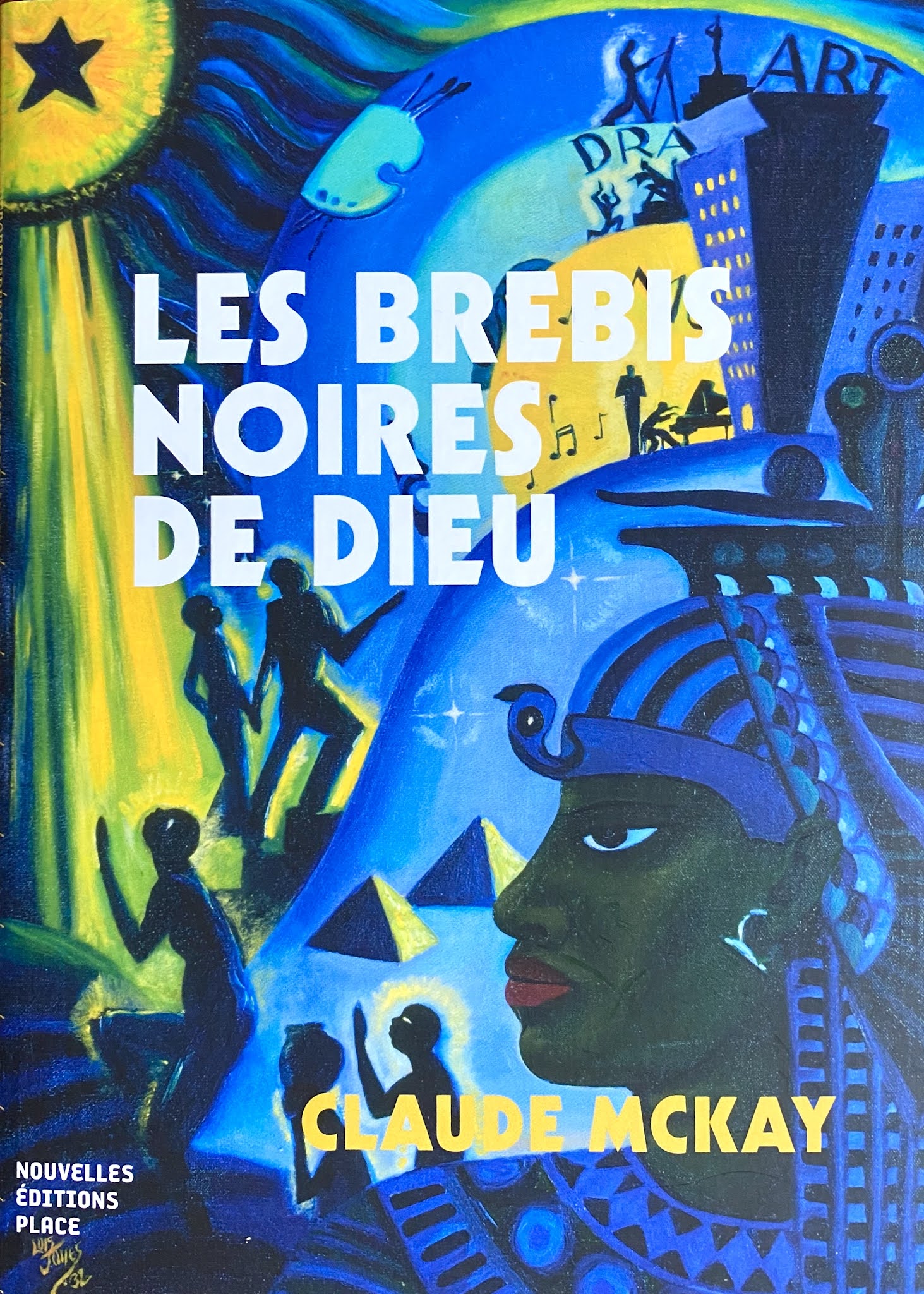
Naudy is the French translator of McKay’s novel Amiable with Big Teeth (Les Brebis noires de Dieu), one of two translations that have hit bookstores in 2021, generating renewed interest in the work of the Jamaican-born writer (1890-1948). McKay was a key figure in the Harlem Renaissance, a "cultural nomad" who spent time in Europe during the 1920s and 30s, and the author of the famous poem “If We Must Die”.


The first of the two recent translations - Romance in Marseille (Héliotropismes) - was published under its English title last spring, while Naudy’s Les Brebis Noires de Dieu came out at the end of summer during the so called rentrée, the return to routine after the holidays. A third McKay novel, Home to Harlem (Retour à Harlem, Nada Éditions), has meanwhile been newly translated and is scheduled for publication in early 2022.

This feast of McKay’s work has resulted in profiles of the writer in French newspapers such as Libération, with Naudy’s expert translation receiving particular attention because of the intriguing story behind Amiable with Big Teeth. The celebrated “forgotten” work - a “colourful, dramatic novel” that “centres on the efforts by Harlem intelligentsia to organize support for the liberation of fascist-controlled Ethiopia,” as Penguin Books describes it - was discovered only in 2009 by then graduate student Jean-Christophe Cloutier while doing research. His discovery came 40 years after McKay had completed the manuscript.

Cloutier and his advisor Brent Hayes Edwards went on to confirm the authenticity of the work, and it was published by Penguin in 2017. Fully aware of this history, Naudy said it was “mind-blowing” to translate the novel, and he drew upon his own background for the rendering into French.

Born in Paris, Naudy studied Francophone literature at the Sorbonne University and design at the Jan van Eyck Academy in the Netherlands. He describes himself as a publisher, translator and “text experimentalist”, and he coordinates "Déborder", a book series published by independent publishing house Nouvelles Éditions Place. Within this series, he has translated African Journey by Eslanda Goode Robeson (2020) and now the McKay novel.

As a writer, Naudy, under the name of Société Réaliste, has himself published two books, in addition to essays and experimental texts in journals and reviews; and as an artist he has exhibited work in both solo and group shows internationally. One can find examples of his public art pieces around Paris.

The following edited interview with Naudy, conducted by email and in person, is part of SWAN’s series about translators of Caribbean literature, done in collaboration with the Caribbean Translation Project.


SWAN: How did the translating of Aimable with Big Teeth come about?


Jean-Baptiste Naudy: In 2019, Sarah Frioux-Salgas and I were invited by Cyrille Zola-Place, director of Nouvelles Éditions Place in Paris, to curate a book series dealing with unclassifiable texts, overreaching genres, intertwining topics. Our common interest for the internationalisation of political and poetical scopes in the 20th century, via the publication of books largely ignored by the classical Western frame of reference, gave birth to this book series, entitled Déborder (To overflow). The first book to be included was a reprint of Negro Anthology, edited by Nancy Cunard in 1934, a massive collection of poetry, fiction and essays about the Black Atlantic, for which she collaborated with paramount artists and scholars of those years, Langston Hughes, Zora Neale Hurston, George Padmore and dozens of others. 


Since then, we have published five more books in this frame, like the first French translation of Eslanda Robeson’s African Journey, or Sismographie des luttes (Seismography of Struggles), a kind of world history of anticolonial journals, amazingly edited by art historian and writer Zahia Rahmani.

At the beginning of 2020, Sarah told me the story of a newfound book by Claude McKay, Amiable with Big Teeth, edited by Brent Hayes Edwards and Jean-Christophe Cloutier for Penguin Books in 2017. Searching the archives of a rather obscure New York publisher, Cloutier had found the complete and ready-to-be-published manuscript of a completely unknown novel by McKay. The very fact that such a story was possible - to find out of the blue a full book by a major writer of the 20th century - was unfathomable to me. Nouvelles Éditions Place immediately agreed to the idea of publishing the book in French.

SWAN: Including your translation, there will be three novels by McKay published in French this year and next. Can you explain this surge of international interest in his work?


JBN: The renewed interest in Claude McKay’s oeuvre is global for sure, but also at times pretty local. The critical deconstruction of the Western ideological frame of thought has called for the exposure of another cultural grounding, a counter-narrative of modernity, other stories and histories encompassing the plurality and complexity of dominated voices, visions, sensibilities, positions on their path to liberation. To that extent, McKay is an immense writer, whose very life was bound to this intertwining. Like most of the key figures of the Black Atlantic, he has been largely ignored or under-appreciated by the 20th century literary canon. More than ever, he is a lighthouse for those interested in the interwoven problematics of race, gender, sexuality, and class. But he is as well a singular figure of displacement, a critically productive internationalist, being at first a Jamaican in New York, then a Caribbean from Harlem in Europe, then a Black writer from France in Morocco, and finally back to the United States, a Black Atlantic wanderer.


Which is also the point of his renewed presence in the French contemporary cultural landscape. The very fact that one of the most preeminent actors of the Harlem Renaissance was, first, a Jamaican, and second, writing from France about the Americas and the global Black diaspora is irresistibly intriguing. Another important factor is the crucial influence that McKay’s writings had on a number of Francophone literary figures of the 1930s, including the founders of the Négritude movement, the Nardal sisters, Aimé and Suzanne Césaire, Léon Gontran Damas, René Ménil, and many others.

In a nutshell, I would argue that McKay captivates nowadays for all those reasons at the same time. He epitomizes the Black international radical current that rose in the 1920s and 1930s, his critical scope is extremely contemporary, and he is representative of a certain blend of political and cultural cosmopolitanism that happened to exist in the French imperial metropole during the interwar years. It is interesting to notice that the three books being published now in France deal with different periods of his life: Home to Harlem, his 1928 bestseller (translated Retour à Harlem in the new French translation to be published by Nada Éditions) is a luxurious portrait of Harlem in the 1920s, written while he was in France. Romance in Marseille, released last April by Héliotropismes, another previously unpublished novel from the early 1930s, revolves around the central themes of his most famous novel also set in Marseilles, Banjo. And thus, Amiable with Big Teeth, dating from 1941, being his last fiction and only novel ever written in the United States.

SWAN: In addition to your native French, you speak English and Spanish. Where and how did you begin learning other languages?

JBN: Where I grew up, English and Spanish were mandatory at school. So, I grasped some elements there, quite poorly. Then I had to travel. So, I learned most of my English with Ukrainian artists in Lisbon and bits of Spanish with Brazilian anarchists in Athens. How romantic…


SWAN: How did your interest in translation start?

JBN: My first encounter with the need to translate something happened I guess when I went to London for the first time, in 1997. Following a totally random move - because I liked his name - I bought a washed-out copy of Kamau Brathwaite’s Middle Passages. I had never read anything like that. For sure it sounded like street music to me, half a drunkard rant, half an esoteric psalmody, but the polyphony at work in this single text, the sound and visual poetics of patwa mesmerized me. 

So, for the last 25 years, I have been trying to translate exactly that, the very sensation I had in front of this palimpsest of languages. A rant that would be a psalmody, at times unintelligible, at times neat as a scalpel slice. How language can be haunted by the spectre of the past while echoing potentially emancipated futures. What Rimbaud called “the long, immense, rational derangement of the senses”, inscribed on a page where words are sounds are signs are ciphers are colours are noises are tastes are notes and nevertheless, never more than words.

SWAN: Can you tell us more about other works that you’ve translated and how you selected these?


JBN: Last year, I translated African Journey by Eslanda Goode Robeson, and it was a delight. I have an intense admiration for Eslanda Robeson, an amazing transnational feminist networker and anticolonial advocate. This book was a great success in the USA when it was published in 1945, the first popular book about Africa written by an African American writer. It is a travel diary, at the same time complex and honest, but I particularly liked how Robeson used this genre to create commonality between Africans and Americans. For the anecdote, Eslanda Robeson and Claude McKay really disliked each other, their writing styles are almost opposite, as well as their social backgrounds and cultural framings; however, I think they were aiming at the same liberation and I love them both!


SWAN: How important is translation for today’s world, especially for publishing underrepresented communities? In the Caribbean, as in other regions, it sometimes feels as if countries are divided by language. How can people in the literary and education spheres help to bridge these linguistic "borders"?


JBN: When I was a student, I had the opportunity to study what we call in my country “Francophone literature”, so literature written by former and present subjects of the French colonial project. Or raised in the postcolonial remains of the French empire. What was interesting for me was to try to understand or feel what the colonial condition was doing to the language itself. How writing or expressing oneself in a foreign language, an imperial language imposed upon a great variety of cultures, was transforming the language in return.

At its core, Francophone literature has a poetical abundance and a political tumult that always seemed to me in synchronization with the modern condition. Whatever be the scale and the observation point. What people from my neighbourhood in Paris, coming from all corners of the world, were doing via the vernacular popular French slang we were talking every day, the “Francophone” writers were doing the same to literature itself. Upgrading it to a world-scale. As any other imperial language, French does not belong to French people, fortunately, and that is the main source of its current literary potency as well as the only sound reason to continue to use it.

The political side effects of this linguistic colonial and then postcolonial condition astonished me as well: how this shared imperial language allowed Caribbean peoples, Arabs, Africans, Indochinese, Indians, Guyanese, to relate and elaborate a common ground. This tremendous poetic force and its radical cosmopolitan perspective bound me to translation, especially when I experimentally realized that the situation was exactly the same with all the other imperial languages, English, Spanish, etc. Suzanne Césaire was maybe one of the first poets to see the Caribbean not so much as separated islands (divided by bodies of water, empires, languages, political status) but as an archipelago, an extremely complex panorama whose unity is undersea and underseen. I consider that my task as a literary translator working on the Atlantic world is to help languages undersee each other. I aim to be a pidginizer.

SWAN: What are your next projects?

JBN: I am working on several translation projects. First of all, an amazingly powerful collection of short stories by South African wonder writer Stacy Hardy. Then, a beautiful and crucial book by Annette Joseph-Gabriel, Reimagining Liberation, dealing with the key role played by Black women in the decolonization of the French empire. Finally, I will work on the first French translation of The Practice of Diaspora, an essential book by Brent Hayes Edwards, focusing on Paris as a node of the Black Atlantic culture in the interwar years. Its subtitle says it all: Literature, translation and the rise of Black internationalism. This masterwork constructs an analytical frame to relate together René Maran, Alain Locke, Paulette Nardal, Claude McKay, Lamine Senghor, George Padmore, Jessie Fauset, Langston Hughes, C.L.R. James, Tiemoko Garan Kouyaté, and so many more. As you can easily imagine, it is a mind-blowing book, and I am extremely proud to work on it. - AM /SWAN


Photos: top to bottom: the cover of Les Brebis noires de Dieu; Jean-Baptiste Naudy in Paris (photo by AM); Voyage Africain by Eslanda Robeson; the Libération article on the translation of Claude McKay’s work; Middle Passages by Kamau Brathwaite (New Directions); Aimable with Big Teeth (Penguin).
Thursday, 21 October 2021

ARTIST ASKS UNCOMFORTABLE QUESTIONS AT PARIS FAIR

How does injustice make you feel? Do you see yourself as a perpetrator, or as a victim? Is there any such thing as neutrality? These are some of the questions that Dorian Sari asks through their artwork, which includes blurry photographs with violently shattered glass frames.

The award-winning Turco-Swiss artist - who uses the pronoun they - has a solo booth at the current International Contemporary Art Fair in Paris (FIAC), and their work invites viewers to  question reactions and stances when it comes to societal norms. Who, for instance, has thrown the stone that is glued to the cracked glass?

“When people look at this, they rarely see themselves as the perpetrator, but we all do things that exclude others,” says Sari, who is represented by Turkish gallery Öktem Aykut, one of 170 galleries taking part in FIAC this year.

On from Oct. 21 to 24, the annual fair did not happen in 2020 because of Covid-19, and its return sees a range of artwork addressing global political and pandemic issues. Sari, who studied political science and literature before art, wonders however if the world has learned anything from the events of the past two years.

The works on display - a tiny chewed-up whistle, a retractable “wall” with spaces for communication if one wishes, two large photographs and a book titled Texts on Post-Truth, Violence, Anger - are meant to spark even deeper reflections about identity and affiliation. (The book was published by the Kunstmuseum Basel when Sari had an exhibition earlier this year, after winning the Manor Art Prize - an award that promotes young visual artists working in Switzerland.)

The intended discomfort is even evident in Sari’s choice of title: “Ding-dong, the itch is back!”, and countries aren’t exempt. Can a nation claim neutrality when they sell arms, the artist also asks, through an illustration showing a gun emitting a red flag that has a white “x” in the middle.

Sari took time out from their busy schedule at FIAC to discuss these concerns. Following is the edited interview.

SWAN: What inspires your work?

SARI: My latest research was on the topic of post-truth, a political adjective for what’s happening in the 21st century. It means that we’re bombarded with information every day, but at the same time nobody knows if this information is true or not. We also live in a technological period where algorithms … just want people to consume more. To keep you on the platform, they show you something that you like, then a more radical version, and then something even more radical. There is so much polarisation and separation in the world, and this is one of my biggest interests. At the FIAC, I’m showing some of the works I showed at the Kunstmuseum in Basel and also at Öktem Aykut in Istanbul. With this series of photographs, I was interested in seeing the relationship between the victim and the perpetrator because we always think that what we do is the right thing, and it is always others’ fault. I wanted to change this position. Whoever is looking at the photograph is the stone-thrower but even though I give this position, people still prefer to identify as the victim. But even if you’re neither, and you’re just watching and being silent, that third option is also problematic.

SWAN: What is behind the “itch” in the title of the photograph series?

SARI: It’s a series of 10 photos, and the “itch is back” means there’s an uncomfortable feeling inside, so you scratch your body. Maybe this discomfort comes because there’s something that the stone-thrower doesn’t want to know, doesn’t want to see. It can be anything.

SWAN: So, the aim is to make us question our own itch?

SARI: Exactly. And to question what we reject, what we throw stones at in daily life, because we do it so much. We exclude so many things. I always believe we’re separated through the adjectives: the moment we’re born, they tell us our gender, they tell us our nationality, they tell us our religion, they tell us our social class, language, everything. Everything is automatically put on us, and it’s already part of our separation because one group doesn’t want the other group, and di-di-di-di-di-di. But after all, I believe in love, and I believe love doesn’t have a gender, race, social class. Love is love.

SWAN: And the whistle?

SARI: There are so many people who wear a whistle as a necklace, or carry it on a keychain or in their bag, so that in case of something violent in the streets, they can raise an alarm, make their voices heard. Or, in case there’s an earthquake… I was thinking that someone could have so much fear and anxiety, waiting for something to happen. And the whistle could be like a pencil - when you don’t use it, you chew on the end. And I thought that someone waiting for something bad to happen would chew on the whistle. So, it’s like auto-destruction: you eat your own voice in order to be heard because of fear.

Photos (top to bottom): Dorian Sari with artwork at FIAC; the exterior of the art fair venue in Paris. Photos by AM/SWAN.

Wednesday, 6 October 2021

REVIEW: COSTA RICAN FILM PROBES A LONER'S HEART

By Dimitri Keramitas

Clara believes that everyone has a secret name. But hers is hiding in plain sight and is linked to her excruciating solitude, as depicted in the debut film of Costa Rican-Swedish director Nathalie Álvarez Mesén.

The eponymous protagonist of Mesén's Clara Sola suffers from a twisted back for which her mother refuses an operation, and this disability both aggravates and illustrates her existential condition on a literal level. The irony, however, is that she lives in what seems to be some kind of paradise - an Eden populated almost entirely by a convivial family of women. 

The director and her skilful cinematographer (Sophie Winqvist Loggins) portray the thick forest and grassland of the film's setting with both assured exactitude and lushness, and Mesén also vividly depicts the Marianist cult that the family has created - a cult that’s at the centre of the movie.

Clara (Wendy Chinchila Arraya) claimed at some point to see a vision of the Virgin Mary, which may well have been a hoax perpetrated on her religious mother. Nevertheless, the maniacally pious mother (an imposing Flor María Vargas Chavez) has built a shrine and invites the public to come and seek Clara’s healing benedictions.

One might think that the cult of the Virgin would lead to female empowerment, but here it is portrayed as life-denying and anti-sexual. This is naturally contradictory, as the mother had to have had a husband to bear not only Clara but another daughter, now deceased. And that daughter herself had a daughter, María (Ana Julia Porras Espinoza).

It is María’s fifteenth birthday fiesta - the quinceañera, an important rite of passage in Latin America - that supplies much of the surface plot of the movie. We follow the meticulous planning for a large-scale reception, with music, dancing, sumptuous food. Special dresses are made for María, and also for Clara, who we somehow understand never had a quinceañera of her own.

Arraya does a tremendous job of portraying Clara, fully inhabiting the character. Physically, Clara is very severe-looking (and saddled with that twisted spine), but we feel the vital woman straining to get out. Glimmers of life shine through the apparent emotional and intellectual stuntedness, and we see her chafing at the iron-fisted rule of her mother, while enjoying warm relations with her niece María. Perhaps it’s the sight of María transitioning from pubescence to adolescence and sexuality that sets Clara off. For the fifteenth birthday party, she insists on a blue dress, like that of her niece, rather than the red dress her mother has chosen.

The other factor that catalyses Clara’s attempted metamorphosis (and catalyses the movie as well) is the arrival of a male hand, Santiago (Daniel Castañeda Rincón in a charismatic, warmly empathetic performance). Handsome, with a rich baritone voice, he attracts both Clara and María. We might normally expect Santiago to be drawn to María, but he and Clara gravitate towards each other on a deeper level. Both of them have a strong indigenous look, as opposed to the conventionally feminine (and European-looking) María.

The director uses a few motifs to drive home her theme of life pushing against constraints. There is the family’s beautiful white horse, Yuca (which the mother is trying to sell). Clara behaves ambivalently towards the horse, trying to get him to do her bidding, but also wanting him to be free. There’s also a large beetle that Clara finds and keeps (or imprisons) in a box. These motifs might seem to spell things out a bit too obviously, but they resonate with viewers.

As Clara gradually comes out of her hard, ungainly shell, the story resembles a Central American take on Cinderella. Pushing these archetypal buttons still works on our emotions (as it does in the recent updated Cinderella movie). But this isn’t the most effective aspect of the film, just as the climactic scene at the birthday party, which the director films like a more realistic version of the prom scene in Carrie, and Clara’s ultimate disposing of the home shrine to the Virgin (reminiscent of the house-burning scene in Terence Malick’s Badlands), are powerful, but over the top.

It is the quieter but often surprising scenes that strike the deepest chords, such as an encounter between Clara and Santiago, where Clara, supposedly the needy one, turns the emotional tables. Just as she has her secret name, she tells him his (whispering it out of earshot of the audience). We never find out Santiago’s hidden name, though we might guess. But we already know Clara’s secret name from the start - “Sola”. The film may well make you wonder about your own.

Clara Sola was presented at the Quinzaine des Réalisateurs section of the 2021 Cannes film festival, held earlier this year. It is a joint production of Costa Rica, Belgium and Sweden (where the director has lived and studied) and will be in French cinemas in spring 2022.

Production and distribution: Needs Productions, Pacifica Grey, Luxbox Films, Epicentre Films

(ED: AM / SWAN)

Sunday, 26 September 2021

MEXICAN ILLUSTRATORS BLUR ART LINES IN PARIS SHOW

So, what’s the difference between illustration and “art”?

When asked this question, Maru Aguzzi replies with a wry smile: “Perhaps the price?”

Aguzzi is the curator of Gran Salón México-Paris - Contemporary Mexican Illustration, an exhibition taking place at the Mexican Cultural Institute in the French capital until Oct. 26. The show brings together some 40 illustrators, whose work includes painting, drawing, print-making, video and other genres.

The pieces are strikingly artistic, even if they’re being presented as illustrations. All are “original” works created especially for this exhibition, which is the first in France from Gran Salón México, an annual art fair that Aguzzi created in 2014.

The fair’s mission, she says, is to offer a glimpse into the country’s growing illustration “wave”, and to bring to the public some of the best contemporary works in this category - a field that actually “plays” with the limits of art.

“Saying that price makes the difference is perhaps the funny answer, but you can go deeper and see how illustrators choose to explore content or not,” Aguzzi told SWAN. “The way the work is presented, viewers don’t have to dig for content or meaning as with contemporary art, where the work requires some kind of engagement from the viewer for completion. Illustration has an immediate impact, and viewers can like what they see or not. It’s that simple.”

Gran Salón’s participating illustrators use a variety of media just like their “artist” peers, she said. Works in the show range from oil and acrylic paintings on canvas to charcoal drawings on paper. In between, viewers can enjoy watercolours, collage, animation and digital art.

In fact, some of the illustrators do exhibit in art fairs as well, further blurring distinctions, Aguzzi said. They draw on a long tradition of Mexican artists working in various genres, as did renowned painters Diego Rivera and Rufino Tamayo - whose influence can be felt in the current show, alongside that of multi-genre Spanish artist Pablo Picasso, for instance.

Picasso and his paintings of women are evoked with a twist in the illustrations of Rocca Luis Cesar (born in Guadalajara in 1986), while the more “veteran” Carlos Rodríguez (born in La Soledad, San Luis Potosí, 1980) draws upon images - such as the watermelon - that appear in the paintings of Tamayo.

Both illustrators convey a strong artistic sensibility, with Rodríguez in particular being inspired by “classical painting, mythology, naïve art and porn” - as his bio states. His two vibrant, erotic paintings in the show were created specifically to conjure a Latin American ambience in Paris, Aguzzi said.

Another notable aspect of the exhibition is its sense of humour or satire, in addition to the addressing of serious topics, such as climate change and language rights. One of the youngest illustrators, María Ponce, born in Oaxaca in 1994, exemplifies this with her colour drawings about daily life and with her “Creciendo juntos” piece, which transmits the message that we have to take care of the environment and trees if we too wish to keep thriving.

Meanwhile, illustrator and filmmaker Gabriela Badillo (born in 1979) uses her work to highlight Mexico’s indigenous languages through her 68 Voces project, a video series with stories told in these languages. Badillo co-founded audiovisual production company Hola Combo with a belief in the social responsibility of media, according to the exhibition, and she and her colleagues have worked with indigenous groups, including children, on creative initiatives. 

Her videos, and other film clips and works of animation, add to the unexpected scope of the Gran Salón show.

“The work that illustrators are producing in Mexico includes numerous genres, and I really wanted to show this range,” Aguzzi told SWAN.

Photos (top to bottom): Maru Aguzzi at the exhibition in Paris, in front of works by Alejandro Magallanes (photo by SWAN); 'Autorretrato' by Rocca Luis Cesar, photo courtesy of Gran Salón México; 'Creciendo juntos' by María Ponce, photo courtesy of Gran Salón México

Additional information:

https://icm.sre.gob.mx/francia/index.php/fr/ & https://gran.salon/ 

Friday, 10 September 2021

WRITER AMITAV GHOSH WANTS THE NOVEL TO DO MORE

By Dimitri Keramitas

PARIS – Indian author Amitav Ghosh bemoans the fact that the novel isn’t dealing with current reality.

Speaking with readers in the French capital on the publication of La Déesse et le Marchand (the translation by Myriam Bellehigue of his novel Gun Island, Actes Sud), Ghosh debated whether this literary form is relevant or not, as he addressed pressing world issues such as climate change and migration.

“The novel doesn’t deal with the issues that are so important for the survival of civilization, but instead focuses on individuals’ subjectivity,” he told readers during a lively discussion earlier this month at bookstore l’Arbre à Lettres in the Bastille area of Paris.

Ghosh has devoted himself to these mega-concerns since the publication of his nonfiction book The Great Derangement, and he has also won acclaim for Sea of Poppies, a novel that deals with the tumultuous encounter of European and Asian civilizations in the 19th century. He is also celebrated for The Glass Palace, which has been translated into more than 25 languages.

Ghosh said that he considered the novel to be inherently conservative in form, and difficult to change. Without giving examples, he said that film was much more adaptable, but, at the same time, he acknowledged that the novel’s vivid elements - scene-making and dialogue - had continuing vitality.

For Ghosh, John Steinbeck’s The Grapes of Wrath is the great novel of climate change. (Steinbeck’s classic deals with the migration of “Okies” as a result of “dust bowl” conditions in the 1930s that rendered much of the United States an agricultural wasteland.)

However, Ghosh said that if the novel had been written today, it would necessarily include many Hispanic characters, which would also affect the work’s language. He added that the novel form suffers from monolingualism, and that it needs to address today’s cross-pollination of languages and cultures.

“The novel is usually limited to one language, for example English. But if The Grapes of Wrath were written today, it would have to include Spanish. Migration nowadays concerns people from Africa to South Asia, and fiction dealing with the subject must incorporate other languages.”

He noted that in the past, the Western literary tradition was actually less monolingual.

“A writer in medieval France would have spoken two languages, French and Latin,” he noted, although he might also have mentioned regional languages such as Provençal, Occitan and Breton.

When Ghosh spoke more directly about migration, he emphasized that the underlying issues for people's movement were more complex than just climate change. He described doing first-hand research among Bangladeshi and other migrants in Italy. He said that none of the migrants he spoke to accepted the term “ecological migrant”.

“Migration is complex and there are many reasons people leave their countries. Political, religious, economic, familial,” he stated. He found that most of the migrants weren’t happy with their lot in Europe and felt trapped there.

“They felt they’d made a mistake, leaving behind their family bonds, communities, language and traditions, and would return if it were possible,” he added.

In response to a question, he said he chose Italy, as opposed to France or Greece, for his research because he was more familiar with the country and its language, and had friends there. He was able to communicate with those from his home region (he’s from Calcutta in West Bengal, while Bangladeshis are from what used to be called East Bengal, with Bengali the common language).

“One of the key aspects of the migrant experience is that those who would explain it do not speak the migrants’ language. Journalists and others don’t speak Bengali, so they interpret migrant reality in English.”

A member of the audience, also from Calcutta but residing in France and working with refugees, pointed out another aspect of the communication gap: Many refugees, when questioned or interviewed, tend to say what they imagine others, who might help them or have power over them, want to hear. The author agreed with her observation.

He added that mounting migration was perhaps the single most important factor in recent political developments. He said that migration accounted for the rise of the extreme right in Europe, for Brexit, and for the election of Donald Trump. Asked about his own country, Ghosh said that the same issues had led to the rise of Hindu nationalism.

“While there aren’t many people crossing India’s borders, there have been problems with the situation of forest people and other minorities,” he said.

Ghosh also highlighted the role that technology, particularly smartphones and social media, play in migration.

“Much migration couldn’t take place without it, (for) persons who fly into Libya or go through the Balkans. One migrant travelled from Bangladesh to Europe on foot, over a year and a half. This just wouldn’t be possible without today’s communication technology,” he told the audience.

Surprisingly, while focusing on the large-scale problems of the day and the need for the novel to deal with them, Ghosh also made a case for phenomena that surpass conventional notions of what’s real. He said people encounter uncanny, inexplicable events all the time, and called this preternatural, as opposed to supernatural. He gave an example from his novel, the temple that appears in it.  When asked about this, he answered that he’d invented it, but sometime after the book was published, an American geologist contacted him with information about a temple that had been unearthed in the novel’s setting, which bore a striking resemblance to the fictional one.

La Déesse et le Marchand / Gun Island – Ghosh’s most recent novel - is phantasmagorical and originates in a Bengali folktale about a merchant who crosses (and then must flee) the goddess of snakes Manasa Devi. This might seem like indulging in magic realism, but it is actually a way to look at our current predicament, he indicated.

Photos (top to bottom): Amitav Ghosh (by D. Keramitas) and the cover of La Déesse et le Marchand (Actes Sud).

Follow SWAN on Twitter: @mckenzie_ale

Tuesday, 27 July 2021

REVIEW: BRAZILIAN FILM DELVES INTO REALITY, PHYSICS

By Dimitri Keramitas

Brazilian director Carlos Segundo has made an arresting, engaging movie with Fendas, but it probably will not be everyone’s cup of coffee.

On one level, the film is a meditation on reality versus perception, and, on another, it’s a speculation about how scientific research into natural phenomena may enable us to comprehend emotional states.

This makes Fendas sound very cerebral, and while the science may pull in some viewers, it may leave others feeling adrift. Yet Fendas - a French-Brazilian coproduction that was making the festival rounds before the Covid-19 pandemic lockdowns - also has a gritty and sensual texture true to its South American characters and environment. The combination is what makes the film original, if not entirely successful. 

Roberta Rangel plays Catarina, a researcher and professor of “the physics of poiesis”. Poiesis has several meanings, especially in philosophy, but here it seems to refer to the potential properties of phenomena we create. 

According to certain theories, if such phenomena become fixed by the act of measuring them, or are distorted by observing them, perhaps one’s actions can somehow be retrieved by searching and measuring as well. 

So, Catarina’s research explores the possibility that sounds, particularly those related to living beings, may be conjured out of visual images - out of captured light, and she takes photographs in pursuit of this prospect.

We can’t really see Catarina in teaching mode, however, because the professors are on strike, leaving the school where she works looking like a ghost town, and this is one of two destabilizing events for her. The other is the disappearance of her cat. She continues to come to the classroom, to chat with the sole student who shows up. But we never hear of the cat again in the movie. Does it simply symbolize loss?

The director does cite many scientists and institutions in the movie credits, but he doesn’t really give a clear idea of the link between vision and sound and how time plays into all this.

From a layperson’s perspective, though, there’s enough to spark interest. The earliest attempt to record sound, for instance, was with the phonautograph of Frenchman Edouard Léon-Scott de Martinville, via graphic notation. For more than a century there was no way to mechanically retrieve the sounds in question, but now, using digital methods, researchers have unlocked the old sounds and brought them back to life - using photographs of the original notation that consequently enabled them to reproduce the sounds.

This idea of the role of pictures in sound is pushed further when the director shows us large, disconcerting image-blobs - Catarina’s blow-ups of the photographs she’s taken. This is also reminiscent of Blow-Up (about a photographer who discovers that a detail in a photo actually depicts a murder when it’s magnified), and Brian DePalma’s unofficial remake Blowout (a murder mystery as well, but focused on sound recording).

Yet Segundo equally punctuates his film with black-outs, hinting at the futility of obtaining any definitive meaning from the images.

Just as disconcerting are the dissonant noises of the soundtrack, whether associated with Catarina’s research or with her life (and by extension, her unstable mental state). The director choreographs these sounds and images impressively: they resonate on our nerves like hammers striking piano chords, but their full meaning remains blurred.

At first, the main question of the film seems to concern speculative physics. But then the science merges into a kind of spiritualism, the idea that sounds and images may persist beyond time, even after the death of the persons captured in recordings. We’re reminded of the spiritualists of the 19th and early 20th century who claimed to depict ghostly auras (in the most literal sense) in photographs, most of which were debunked. This becomes linked to the tragic fate of that lone student, Henrique, and also to Catarina’s past relationship with a Frenchman.

Anything is possible, especially in the quantum universe, we think at first. Yet quantum mechanics, subatomic particles, and theory apply only tenuously to our macro, organic reality. So, we begin to wonder about Catarina’s emotional state. She’s beautifully played by Rangel, vividly present physically, and also in her relationships and conversations. This physical quality is emphasized by the director’s filming in a grainy 16mm-ish texture. In addition, there are shots of stark scenery and rough Brazilian terrain as well as cliff-top views of stretches of white-sand beaches.

We might think that the movie will turn out to be another sentimental story about sublimated loss, but, if anything, it’s about loneliness. If Catarina continues to come to the classroom, it’s obviously to see Henrique. Yet nothing serious comes of the relationship. Her only friendship seems to be with a colleague who will soon relocate to France.

Catarina’s contact with Réné, her former partner, also leaves one wondering, and the feeling of isolation is reinforced when she’s seen in desolate landscapes (such as the isolated spit of land where a lighthouse sits), crying out “Is anyone there?” Then, rather pathetically, she asks that if someone really is there that they email her. Her one contented moment is a scene of her masturbating, and one wonders who she might be thinking about then. She’s smiling but her eyes are closed.

Ironically, the “slits” or “cracks” of the title (fendas in Portuguese) refer to the eyes, openings to the visualized world outside, to the light-revealed exterior. The visual is also closely linked to the mental processes that perceive spatially - and also abstractly. But it’s the auditory that’s more related to the body, to the rhythms of music, dance, and intimate movement.

Much as we humans long for unity, and many physicists have been searching for years for a Grand Unifying Theory of the Whole Enchilada, the idea that sound and image are interchangeable seems a profound mistake. Catarina apparently recognizes this at the end, a revelation for both her and for viewers. (Perhaps she can now work on getting another cat.) In the meantime, Segundo is to be commended for serving up a memorable vision of the frayed interfaces between mind and heart, time and space, sight and sound.

Photos provided by Fendas distributors. The film arrives in French cinemas Aug. 4.

Dimitri Keramitas is a writer and legal expert based in Paris.

Wednesday, 30 June 2021

JAMAICAN ARTIST HELPS TO REJUVENATE URBAN AREAS

Bernard Hoyes believes that art can make a difference, and his creations - especially his latest output - attest to this view.

Hoyes, an acclaimed Jamaican-born, US-based painter and sculptor, is increasingly using his work to redefine public spaces, in addition to portraying his Caribbean background and vision. He ranks among the lead artists in “Paint the City”, for instance, a project organized by the Jamaican non-profit group Kingston Creative that has transformed sections of the island’s capital through bold, colourful murals.

Alongside this involvement, Hoyes recently completed the installation of a monumental sculpture titled The Mating Dance of the Hummingbirds, a work now gracing the entrance to the headquarters of the Port Authority of Jamaica in the historical Duke Street district, also located in “downtown” Kingston.

“The idea for this work has its roots back in the Eighties, when I took part in an exhibition with another artist, hanging paintings in buildings that had been burnt out in the political violence of the 1970s,” Hoyes told SWAN. “From that time, the issue of Kingston Restoration was a matter of restoring architectural icons downtown. But the painting of the murals organized by Kingston Creative three years ago sparked a certain momentum where other things started to happen, such as the decision to create the sculptures.”

The Mating Dance is the first sculpture commissioned for Kingston’s “Walking Museum Project”, part of another restoration initiative, funded by local and international bodies including the European Union.

Difficulties occurred, however, after the completion and during the installation process because of the Covid-19 pandemic, Hoyes said. First, his trip to Kingston from his home and work base in California was delayed because he contracted the coronavirus and had to spend two months recuperating. Then, the time it took to clear the sculpture through customs in Kingston was much longer than expected because of lockdowns, following the transportation across the seas in a shipping container.

When the work was finally up, the Port Authority tweeted on May 19 that it “was more than honored to provide the space for this amazing sculpture that is aimed at beautifying the downtown area and making it an attractive tourist destination”.

Composed of stainless steel for outdoor durability, the sculpture features wings made from translucent Lucite rods, containing solar LED lights. The solar components enable sunlight to be captured during the day, providing energy for the wings to “come alive” in multi-coloured hues at nightfall. So, as workers leave their offices in the district, they are greeted by the birds’ luminescence.

For Hoyes, who grew up in downtown Kingston, these public art projects are a way to give something back to the community of his childhood, after a successful global career. He said he was inspired by the Jamaican national motto “Out of Many One People” and the fact that the hummingbird is the national symbol.

The sculpture’s 120-pound steel birds sit atop a 12-foot-high double helix, and this “speaks to the procreation of all species, reminding us that we share the same DNA,” Hoyes said.

Known primarily for his vivid paintings of women singing and dancing in revivalist celebrations, Hoyes has long had an interest in sculpture, even as his paintings were being collected by personalities such as Oprah Winfrey and Natalie Cole.

“I’ve made my reputation as a painter, but when I started out as a youth in Jamaica, I used to carve little wooden heads, so I was already into the 3-D exposure when I was in high school,” he told SWAN. “Then when I moved to California, I realized that sculpture took a lot of start-up money, and as I was very transient at first, I found it easier to roll up canvases and carry them with me.”

He returned to sculpture in 2002, embarking on a residency in China seven years later, and refitting his studio in California to make it more suitable for monumental projects.

In addition to the tributes for his hummingbirds, Hoyes has received praise for his participation in the painting of murals that have transfigured areas of downtown Kingston.

Arts observers say that the more than 60 murals to date have changed the ambience of areas long-considered no-go zones because of neglect, crime and gang warfare - even if much more still needs to be done economically to help residents.

Andrea Dempster-Chung, the Executive Director of Kingston Creative, told SWAN that it has been “a huge honour” for the Downtown Kingston Art District to have “public artworks by an artist of Hoyes’ calibre”.

“Hoyes was raised in Downtown Kingston, in a community called Kingston Gardens and so he is of this community,” Dempster-Chung said in an email interview. “He is a local artist that migrated and succeeded in the US, where he is primarily recognized as a contemporary painter whose work evolves from a highly intuitive space. He is heralded for his ability to capture spiritual realms on canvas in radiant and brilliant essence.”

She explained that the inspiration behind Kingston Creative was “to find a way to harness” the Caribbean island’s “raw talent” and to convert it into “sustainable social transformation” and economic growth.

She added that although creativity is an area where Jamaica has “an undeniable global competitive advantage”, it is not yet being used to “convert raw talent into growth, as the ecosystem isn't sufficiently developed for artists and creatives to thrive”.

“Arts and placemaking can also generate employment, regenerate urban areas in a balanced and inclusive way and support reduction in crime, all of which would be amazing outcomes for Jamaica,” Dempster-Chung said.

She told SWAN that once Hoyes had heard of the project, which was launched in 2018, he wanted to get involved.

“Bernard contacted us online, then came in person to an event and volunteered to paint the very first mural in the Art District,” Dempster-Chung recalled.

“Aptly titled ‘Celebration’, the mural has become an iconic fixture in the Art District and celebrates the re-emergence of Downtown Kingston as a creative space.”

Artists who supported Hoyes in painting this mural included Jeanna Lindo, Alec Champanie and Osemere Ehikhametalor. 

“We did this mural all in one week,” Hoyes told SWAN. “We started like on the Wednesday and finished up on the Sunday. But there were a lot of other artists that had individual murals, so we all worked together during that period. It has been an incredible experience.”

PHOTO credit: Doris Gross. Images (top to bottom): Bernard Hoyes with The Mating Dance of the Hummingbirds; the sculpture at night; one of Hoyes' iconic paintings; the mural Hoyes spearheaded.  

For an earlier profile of Bernard Hoyes, see:

https://southernworldartsnews.blogspot.com/2013/10/jamaican-artist-soars-through-magical.html

Wednesday, 19 May 2021

GHANAIAN PHOTOGRAPHER IN LONDON RETROSPECTIVE


The largest survey to date of work by the acclaimed Ghanaian-British photographer James Barnor opens in London May 19 at the Serpentine Galleries.

The show, titled “James Barnor: Accra/London - A Retrospective”, runs until Oct. 24 and gives an overview of a career that has spanned more than 60 years, two continents and numerous cities, including New York and Paris.

Bettina Korek, chief executive of the Serpentine, said it was “urgent” to present a major survey of Barnor’s photography because “public knowledge of his work does not yet match the influence it has had upon generations of creators who’ve followed in his footsteps.”

Born in 1929 within a family of photographers, Barnor began his profession in the Ghanaian capital in the late 1940s, before moving to London in 1959 and travelling back and forth between continents.

“Central to Barnor’s work is the intimate documentation of African and Afro-diasporic lives across time and space,” according to the Serpentine. “Whether making family snapshots, commissioned portraits or commercial assignment, Barnor approaches the photographic process as a collaborative venture, a conversation with the sitter, and his images are a testament to a lifetime of encounters.”

The show’s organizers said that Barnor has “captured images of societies in transition and transformation” throughout his career, with his work encompassing the genres of studio portraiture, photojournalism and social documentary photography. As one of Ghana’s first photojournalists, Barnor recorded major social and political changes, including the lead-up to his homeland’s independence from British colonial rule in 1957.

The photos in this massive show are drawn from his wide-ranging archive and focuses on the decades 1950–80, selected from more than 32,000 available images, and presented in “broadly chronological” order, the Serpentine said.

Ahead of the retrospective, when the gallery remained closed because of Covid-19 restrictions, the Serpentine organized an online event titled "Portraits for the Future: A Celebration of James Barnor" - which gave the public a taste of the show’s scope.

Held last March, this event presented musicians, artists, and poets such as Nii Ayikwei Parkes paying homage to Barnor, while Michael Bloomberg (Serpentine chairman), model Naomi Campbell and others spoke of his global influence (see: https://www.youtube.com/watch?v=AqhWdoMOWTQ).

“What a journey this has been, what a journey you’ve had,” said Campbell, as she recalled first meeting Barnor in Ghana. “You’re a true visionary, an artist, and your influence on a generation of artists can be felt throughout the world and back, and all these years and today, it grows even stronger.”

During the “celebration”, Barnor recalled in a flim clip how he came to his craft and career. “Photography was in my family,” he said. “So right from the time that I became a little boy, my uncle was taking photographs in the house, and travelling as well. Three or four people in my family were doing photography. Somebody taught my uncle, and one my uncles taught my cousin, who taught me. And there was another photographer, another cousin… and he more or less got me into what I call… journalistic photography.”

Some of Barnor’s iconic shots appeared on the cover of the influential South African culture magazine Drum during the Sixties, as he continued assignments for this publication following the move to London in December 1959. He returned to Ghana in the Seventies, to establish the first colour-processing laboratory in the country, according to the Serpentine. He then settled permanently in the UK in 1994 and now lives in West London.

Asked by Serpentine artistic director Hans Ulrich Obrist how he “photographed freedom”, Barnor said: “I get (freedom) through my life, through my photography and my association with people... I always say it’s better to give than to be given… Civilization flourishes when men plant trees under which they will never sit. When you give... today, it will ripple and many people will get it. Even if you’re not around, that is freedom that matters.” 

The retrospective is curated by Lizzie Carey-Thomas, chief curator at the Serpentine, and Awa Konaté, assistant curator. Several activities are planned around Barnor’s work and around photography in general

Images (top to bottom): Photo by James Barnor at the Serpentine Galleries; James Barnor with South African artists Robyn Denny and Mamela Nyamza in Paris (photo by McKenzie); "James Barnor: Accra/London - A Retrospective" (Installation view, 19 May - 24 October 2021, Serpentine) Photograph: Zoe Maxwell; Ebo Taylor and the Saltpond City Band play at "Portraits for the Future: A Celebration of James Barnor".